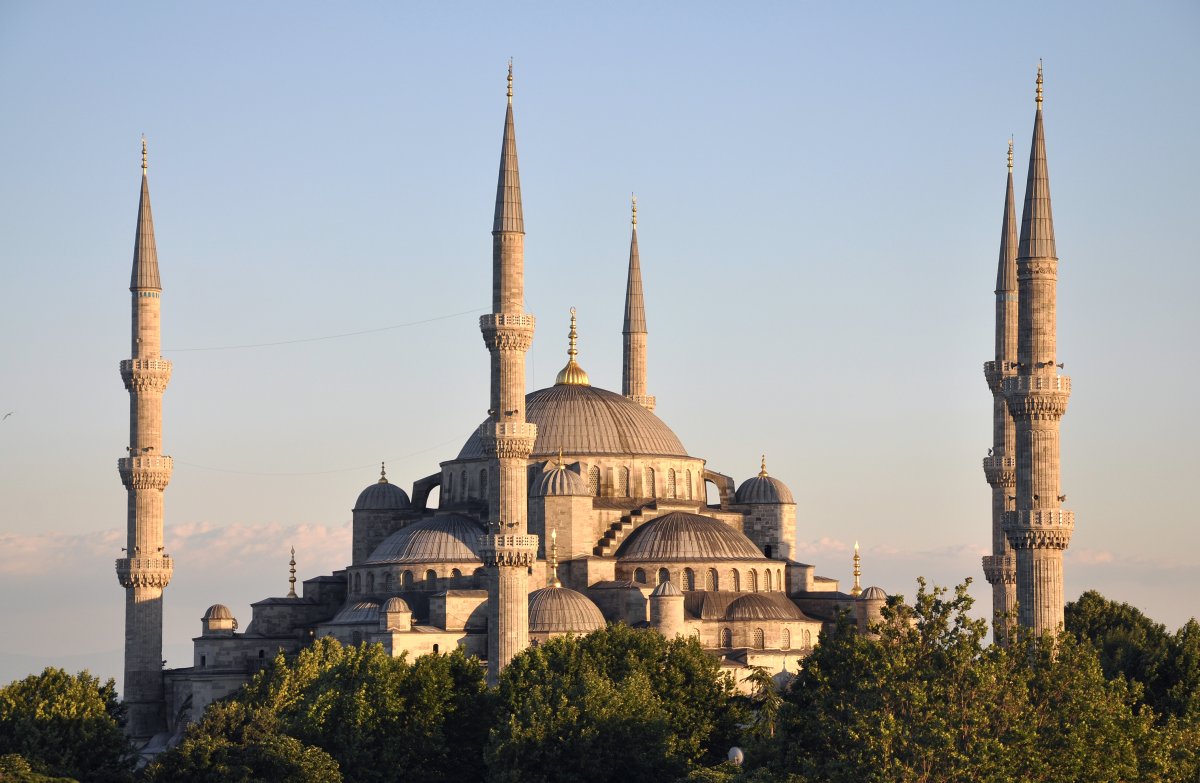

Six thousand square meters of hand-painted tiles, a light filtering through 260 windows and transforming into something almost liquid: the Blue Mosque in Istanbul does not announce itself with a sign, but with a physical sensation. As soon as you cross the threshold and leave behind the noise of the Sultanahmet neighborhood, the interior of the mosque envelops the visitor in a silence colored in blue and turquoise that no photograph can truly capture.
Built between 1609 and 1616 at the behest of Sultan Ahmed I, the mosque is officially known as the Sultan Ahmed Mosque. The project was entrusted to the architect Sedefkâr Mehmed Ağa, a student of the great Mimar Sinan, who had already redefined the standards of Ottoman architecture with the Mosque of Suleiman the Magnificent. Mehmed Ağa took that legacy and brought it to a result that still, four hundred years later, leaves one speechless.
The six minarets: a detail that caused scandal
The most visible characteristic of the Blue Mosque from the outside is the presence of six minarets, a number that at the time of construction was reserved exclusively for the Great Mosque of Mecca. According to some historical sources, the sultan had requested a minaret of gold (altın in Turkish), but the architect may have misunderstood — or perhaps strategically interpreted — the request as altı, meaning six. The controversy was resolved only when the sultan financed the construction of a seventh minaret in Mecca, thus restoring the sacred hierarchy.
Observing the silhouette of the mosque from the park in front, one notices how the six minarets create a perfectly balanced profile: four at the main corners and two thinner ones on the sides of the entrance courtyard. The central dome, about 43 meters high, is surrounded by a cascade of semi-domes and smaller domes that elegantly distribute the weight downwards, a structural elegance typical of the Sinan school.
Iznik Tiles: A Universe of Blue
The interior is dominated by over 20,000 Iznik tiles arranged in panels that cover the walls to a considerable height. The tiles come from the city of İznik, in the current province of Bursa, which in the 17th century was the most important production center of the Ottoman Empire for this form of ceramic art. The depicted motifs include tulip flowers, stylized roses, cypress trees, and geometric arabesques, all created in a palette ranging from cobalt blue to turquoise, with accents of green and coral red.
It is worth noting the color variations: the tiles are not all of the same tone. Those positioned in the higher areas, where the light from the windows hits them directly, appear almost luminescent, while those in the shadowed areas take on deeper and more saturated hues. This effect is not accidental: Mehmed Ağa had studied precisely how natural light would interact with the glazed surfaces throughout the day.
The structure and the internal space
The floor plan of the mosque is based on a square layout with four elephantine pillars — so named for their imposing size, with a circumference of about 5 meters each — that support the main dome. This structural system creates an extraordinarily open internal space, free of intermediate columns that obstruct the view. The red carpet that covers the entire surface of the floor is periodically replaced and contributes to creating a chromatic contrast with the blue tiles of the walls.
The 260 original windows were equipped with Venetian glass, most of which have been replaced over the centuries. The current windows are still effective in distributing light evenly, avoiding areas of excessive shadow. In the central hours of the morning, when the sun is still low but already present, the light enters obliquely and creates reflections on the glazed tiles that make the interior particularly scenic.
How to visit the Blue Mosque
The mosque is still an active place of worship, so tourist access is suspended during the five daily prayers. The best time to visit is right after the morning opening, about an hour after the dawn prayer, when the light is favorable and organized groups have not yet arrived. Entrance is free, but it is required to remove shoes — it is advisable to bring socks — and women must cover their heads with a scarf, available for free at the entrance. A thorough visit takes between 30 and 45 minutes. The mosque is located in the Sultanahmet district, reachable by tram T1 at the same-named stop, just a short walk from Hagia Sophia.