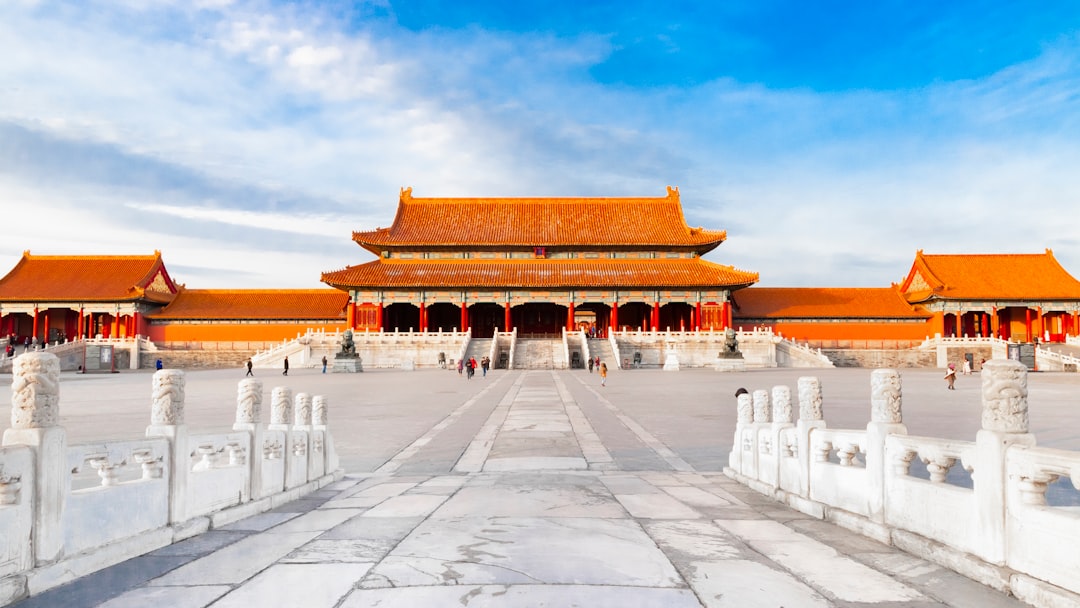

Nine hundred eighty buildings arranged along a north-south axis of almost one kilometer: this is the concrete measure of the Forbidden City of Beijing, the palace complex that for five centuries hosted the Sons of Heaven of the Ming and Qing dynasties. Built between 1406 and 1420 at the behest of Emperor Yongle, the third sovereign of the Ming dynasty, the structure occupies about 72 hectares in the heart of the Chinese capital and was inhabited by 24 emperors until 1912, the year in which the last sovereign Puyi abdicated, bringing an end to the imperial system.
Today the complex is officially known as Palace Museum (故宫博物院, Gùgōng Bówùyùan) and houses a collection of almost a million imperial artifacts, including ritual bronzes, Song and Ming ceramics, silk paintings, jewelry, European mechanical clocks, and ceremonial garments. It is not a museum in the Western sense of the term: the exhibition halls coexist with open courtyards, throne rooms still furnished, and pavilions that preserve the atmosphere of a lived-in residence, making each visit a multi-layered experience.
The collection: ceramics, bronzes, and imperial treasures
The historical core of the collection comes from the collections accumulated by the Ming and Qing emperors over five centuries. Among the most significant pieces are the porcelain vases from the imperial factory of Jingdezhen, recognizable by their cobalt blue backgrounds and white decorations that characterize production from the 15th and 16th centuries. In the halls dedicated to ritual bronzes, it is possible to observe examples dating back to the Shang and Zhou dynasties, some of which are over three thousand years old.
A particularly visited section is that dedicated to clocks and mechanical instruments, many of which arrived at the imperial court as diplomatic gifts from Jesuit missionaries and European traders between the 17th and 18th centuries. The clocks, often of English or Swiss manufacture, are decorated with moving figures, miniature fountains, and automatons: a surprising visual contrast to the aesthetics of the Chinese ritual objects displayed in the adjacent rooms.
The architectural spaces: from the Meridian Gate to the Imperial Garden
The main entrance is through the Meridian Gate (午门, Wǔmén), a U-shaped structure with five arched openings, of which the central one was reserved exclusively for the emperor. After passing through the gate, one crosses the River of Golden Flowers on five white marble bridges before reaching the large courtyard that precedes the Hall of Supreme Harmony (太和殿, Tàihédiàn), the largest wooden building in China, where coronation ceremonies and imperial New Year rituals took place.
At the northern end of the complex is the Imperial Garden (御花园, Yùhuāyuán), designed during the Ming dynasty and remaining largely unchanged. The Taihu rocks, the century-old cypress trees, and the pavilions decorated with colorful pebble pavements create a serene environment that contrasts with the monumentality of the ceremonial spaces. It is one of the places where the crowd thins slightly and where it is easier to stop and observe the architectural details.
Masterpieces Not to Be Missed: Painting and Decorative Arts
The museum regularly displays rotations of paintings on silk and paper from its reserves, as the entire collection cannot be shown simultaneously for conservation reasons. Among the most notable works is the Scroll of River Excursions during the Qingming Festival, a Song dynasty copy of a 12th-century original that meticulously depicts urban life in Kaifeng. The viewing requires time: the scroll extends for several meters and each section reveals scenes of markets, boats, and urban architecture.
The jade collections represent another strength of the museum: white and green jade sculptures of varying sizes, some of which were worked on for decades by court artisans, document a technical and symbolic tradition central to Chinese imperial culture.
Practical Information for the Visit
The standard entrance ticket costs 60 yuan during peak season (April-October) and 40 yuan in the winter period; some special sections require an additional fee. It is mandatory to book online in advance on the official museum website, as daily access is limited. The museum can be reached by the Beijing subway, getting off at the Tiananmen East or Tiananmen West station on Line 1.
To avoid the maximum concentration of visitors, it is advisable to arrive at opening time (generally 8:30) and to walk the main axis in reverse, starting from the Imperial Garden to the north and moving south. Allow at least three or four hours for an essential visit; those who want to delve deeper into the internal exhibition sections should plan for a full day. Comfortable shoes are essential: the stone pavements and the distances between the pavilions make the visit physically demanding.