The trail begins where the asphalt ends. In Latchi, a small fishing port in the Paphos district, a dirt road leads towards the Akamas peninsula, and from there the landscape changes radically: no resorts, no umbrellas, just honey-colored limestone, dense Mediterranean scrub, and the sound of the sea crashing into the underlying caves. The Aphrodite Nature Trail is one of the most pristine hiking routes in Cyprus, a loop of about 7.5 kilometers that crosses the northern part of the Akamas peninsula, the last stretch of Cypriot coastline that remains almost free of development.
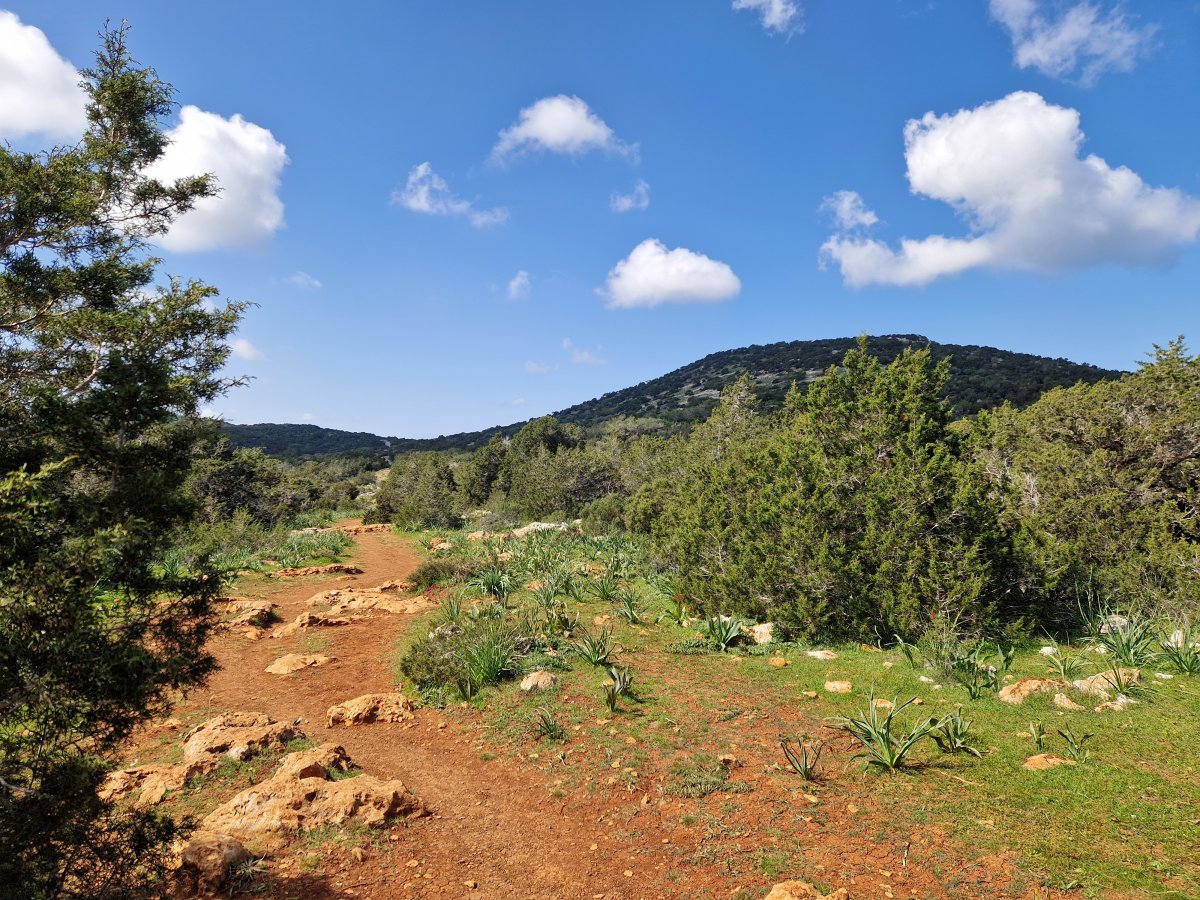
The trail is named after the goddess of beauty, whose connection to Cyprus is as ancient as Greek mythology: according to tradition, Aphrodite bathed in the crystal-clear waters of this coast. Beyond the myth, what makes the route extraordinary is the concentration of different natural habitats in just a few kilometers: pine and juniper forests, coastal garrigue, cliffs overlooking the sea, and seasonal wetlands that in spring host a remarkable variety of wild orchids endemic to the island.
The biodiversity of the Akamas peninsula
The Akamas peninsula is classified as a Special Conservation Area within the European Natura 2000 network, which means that its flora and fauna enjoy formal protection. During a walk in spring — the best time is from March to May — it is possible to observe various species of wild orchids along the edge of the trail, including Ophrys kotschyi, a Cypriot endemic orchid that visually mimics insects to attract pollinators. The flowers are small, camouflaged, and require attention to be noticed among the grasses.
The fauna is equally rich. The sea turtles Caretta caretta and Chelonia mydas nest on the nearby beaches of Lara Bay, just a few kilometers from the trail. Along the route, it is not uncommon to spot raptors such as the Eleonora's falcon (Falco eleonorae) that takes advantage of the thermal currents above the cliffs, or to hear the song of the Cyprus jay (Garrulus glandarius glaszneri), an endemic subspecies of the island. The maquis is dominated by mastic, wild carob, and thyme, and the air in certain stretches has an intense fragrance, especially in the morning hours.
The marine caves and Byzantine remains
One of the most physically impressive elements of the trail are the marine caves visible from the top of the cliffs. The erosion of the limestone has created cavities and natural arches at sea level, some accessible by kayak from the coast. From the top of the path, the variations in water color are clearly visible: turquoise in the shallow waters above the light rock, deep blue in the deeper areas. It is not necessary to have diving equipment to appreciate this spectacle — just lean over from the viewpoints marked along the trail.
About halfway along the trail are the remains of the Bath of Aphrodite, a small natural cave with a freshwater pool fed by a spring. Nearby, signs indicate the ruins of a Byzantine chapel dating back to the medieval period, partially hidden by vegetation. This is not an equipped museum site, but rather stone wall structures made of local stone still standing, intact enough to understand the scale and construction technique of the time. The feeling is one of stumbling upon something by chance, without captions or barriers.
How to tackle the trail: practical tips
The trail is classified as moderate: the elevation gain is not extreme, but the ground is uneven and in certain sections slippery after rain. Sturdy-soled hiking shoes are essential; sandals are not recommended. The average duration to complete the loop is about 3 hours at a leisurely pace, including photo stops. There are no refreshment points along the route, so it is necessary to bring enough water — at least one and a half liters per person in the hottest months.
The most common starting point is the Bath of Aphrodite, reachable by car from Latchi by taking the coastal road north-west for about 9 kilometers. Parking is free and available at the beginning of the trail. Access to the trail is free and unrestricted. The period from June to August is technically not recommended due to the intense heat and drought, which make the landscape barren and the walk tiring. In autumn, the trail is passable with pleasant temperatures, but flowering is absent. For those who want to combine nature and wildlife spotting, April remains the optimal month.
Why it's worth the trip
On an island that has built much of its tourism economy on resorts and equipped beaches, Akamas represents a concrete exception. The debate over its protection has been long and heated — for years there has been discussion about whether to turn it into an official national park — and the peninsula has resisted building pressure thanks to its difficult morphology and the commitment of local environmental associations. Walking on the Aphrodite Trail today means crossing a territory that could be very different in twenty years, for better or for worse.
There are no large facilities, no bright panels, there is no ticket office. There is a path marked with yellow paint on the rocks, the wind coming from the open sea, and the concrete feeling of being in a place that has not been designed for tourists — simply because it has remained as it was.