





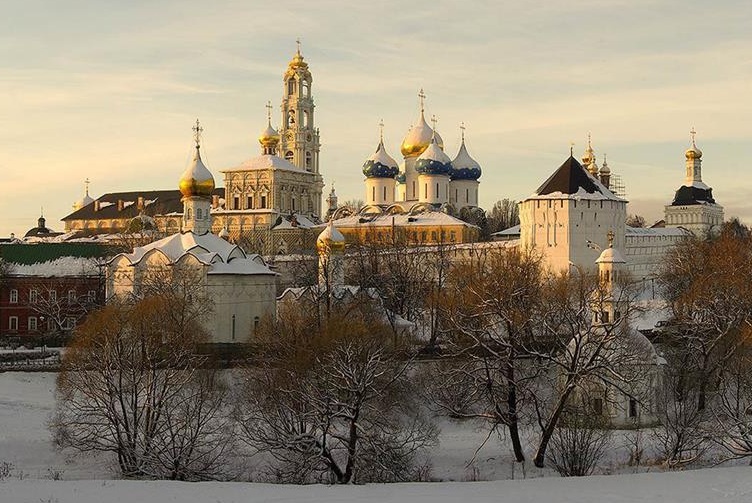
Nestled in the heart of Sergiyev Posad, the Trinity Lavra of St. Sergius stands as a testament to Russia's rich spiritual heritage and architectural grandeur. Ringed in by thick whitewashed walls, its blue and gold onion domes soar to the heavens, setting the imagination aflame. This monastery complex is easily among the most enchanting places on Earth, with colorful mosaics, fanciful wedding cake-styled architecture, and dozens of gold crosses glinting in the light — this is quintessential Russia.
The origins of the Trinity Lavra of St. Sergius date back to 1340, when St. Sergius of Radonezh, a key figure in Russian Orthodoxy, founded this monastic enclave. St. Sergius sought a quiet place for prayer and contemplation, and thus established a small hermitage that soon evolved into a thriving monastic community. Over the centuries, the lavra became an important spiritual center, attracting numerous pilgrims and scholars. It played a significant role during the Mongol invasion and has been a sanctuary for the Russian people during times of strife, including the Time of Troubles in the early 17th century.
The architectural beauty of the Trinity Lavra is a feast for the eyes. The complex showcases a blend of Renaissance and Byzantine styles, characterized by its elaborate onion domes and intricate frescoes. The Cathedral of the Holy Trinity, completed in 1422, is particularly noteworthy, housing the revered relics of St. Sergius. Guests should marvel at the stunning mosaics and frescoes painted by renowned artists such as Andrei Rublev, whose work has become synonymous with Russian iconography. The lavra's bell tower, which reaches a height of 88 meters, is another architectural highlight, offering panoramic views of the surrounding area.
Local culture thrives within the walls of the Trinity Lavra. The monastery is not just a religious site; it is a cultural hub that hosts various traditional festivals throughout the year. One of the most significant events is Sergius Day, celebrated on October 25 (Julian calendar), where thousands gather to honor St. Sergius with prayers, processions, and communal feasting. The lavra's role in preserving Russian Orthodox traditions is paramount, serving as a center for religious education and a venue for cultural gatherings.
Gastronomy in Sergiyev Posad is deeply intertwined with its religious customs. Visitors can savor traditional Russian dishes such as blini (thin pancakes), often served with caviar or sour cream, and borscht, a hearty beet soup. The area's proximity to the Sergiev Posad region also means that honey, especially from local beekeepers, plays a significant part in local cuisine. For those venturing into the monasteries, the lavra's own bakery offers monks' bread, a staple that has been enjoyed by visitors for centuries.
While many tourists flock to the famous sites, several lesser-known curiosities add to the charm of the Trinity Lavra. For instance, the Holy Gate features a unique green and gold entrance that symbolizes the connection between heaven and earth. Additionally, the monastery's library houses ancient texts and manuscripts that are invaluable to historians and scholars. Few realize that the Trinity Lavra was also instrumental in the establishment of the Russian Academy of Sciences, reflecting its broader influence beyond religious life.
The best time to visit the Trinity Lavra is during the spring and early autumn months, particularly from April to June and September to October. These seasons offer mild weather and vibrant foliage, enhancing the beauty of the complex. Visitors should dress modestly, as the lavra is an active religious site, and photography is restricted in certain areas. Be sure to explore the peaceful gardens and take a moment to absorb the tranquil atmosphere that envelops this sacred space.
A visit to the Trinity Lavra of St. Sergius is not just a journey through history; it is an invitation to immerse oneself in the spiritual and cultural essence of Russia. To truly enrich your experience, consider using the Secret World app to plan a personalized itinerary that guides you through this mesmerizing destination.
