Athens puts to the test anyone who wants to plan a DIY trip: the Acropolis opens at 8:00 AM but the lines start an hour earlier, the Monastiraki neighborhood is only a 15-minute walk from the Parthenon but in between there are alleys that do not appear on any standard tourist map, and museums like the National Archaeological Museum require at least 3 hours to be visited properly. Add in the ferries to the islands of the Saronic Gulf — Aegina is 40 minutes away, Hydra is 90 — and you quickly understand why improvisation doesn't work.

In 2026, there are dozens of apps for organizing trips, but not all can handle the complexity of a city like Athens, where millennia-old culture, urban logistics, and islands reachable in a day continuously overlap. We tested in the field the five apps most used by Italian travelers, evaluating destination coverage, itinerary quality, and real usefulness during the visit. Here’s what we found.
Wanderlog and TripIt: great organizers, but with obvious limitations
Wanderlog is probably the most popular planning app among European travelers. It allows you to create collaborative itineraries, import bookings via email, and view stops on a map. In Athens, it works well for organizing structured days — for example, grouping the Acropolis, the Acropolis Museum (entrance about 20 euros), and the Ancient Agora into a single morning on foot. The problem is that its suggestions remain generic: it does not distinguish between a recommended priority entrance and a 45-minute wait in the August sun, and it does not offer historical or cultural context during the visit.
TripIt excels at aggregating bookings — flights, hotels, rental cars — into a single travel document. For those flying into Athens with a layover and then taking a ferry to Santorini, it is a solid organizational tool. However, TripIt is not an experience planner: it does not suggest what to see, does not propose thematic itineraries, and does not offer any support during the visit. It is a smart archive, not a guide.
Google Trips and Roadtrippers: powerful but not designed for cultural tourism
Google Trips — in its integrated version in Google Maps and Google Travel — leverages the power of the search engine to aggregate information on attractions, restaurants, and schedules. In Athens, this translates into accurate cards for the Parthenon, the Temple of Hephaestus, or the Monastiraki market. The limitation is structural: Google provides information, not reasoned itineraries. It does not tell you that visiting Cape Sounion (70 km from Athens, about 1.5 hours by bus) is best in the late afternoon for the sunset at the Temple of Poseidon, nor that the ticket costs 10 euros and includes the complete archaeological area.
Roadtrippers was created for road trips in the United States and, despite international expansion, still shows its North American nature when it comes to European destinations. The coverage of Athens is superficial, secondary attractions — such as the Anafiotika neighborhood, the small Cycladic enclave hidden under the Acropolis — simply do not exist in its database. For a road trip in the Peloponnese, it might make sense, but as a tool for exploring Athens in depth, it is clearly out of context.
Secret World AI Trip Planner: the breakthrough that changes the way we travel
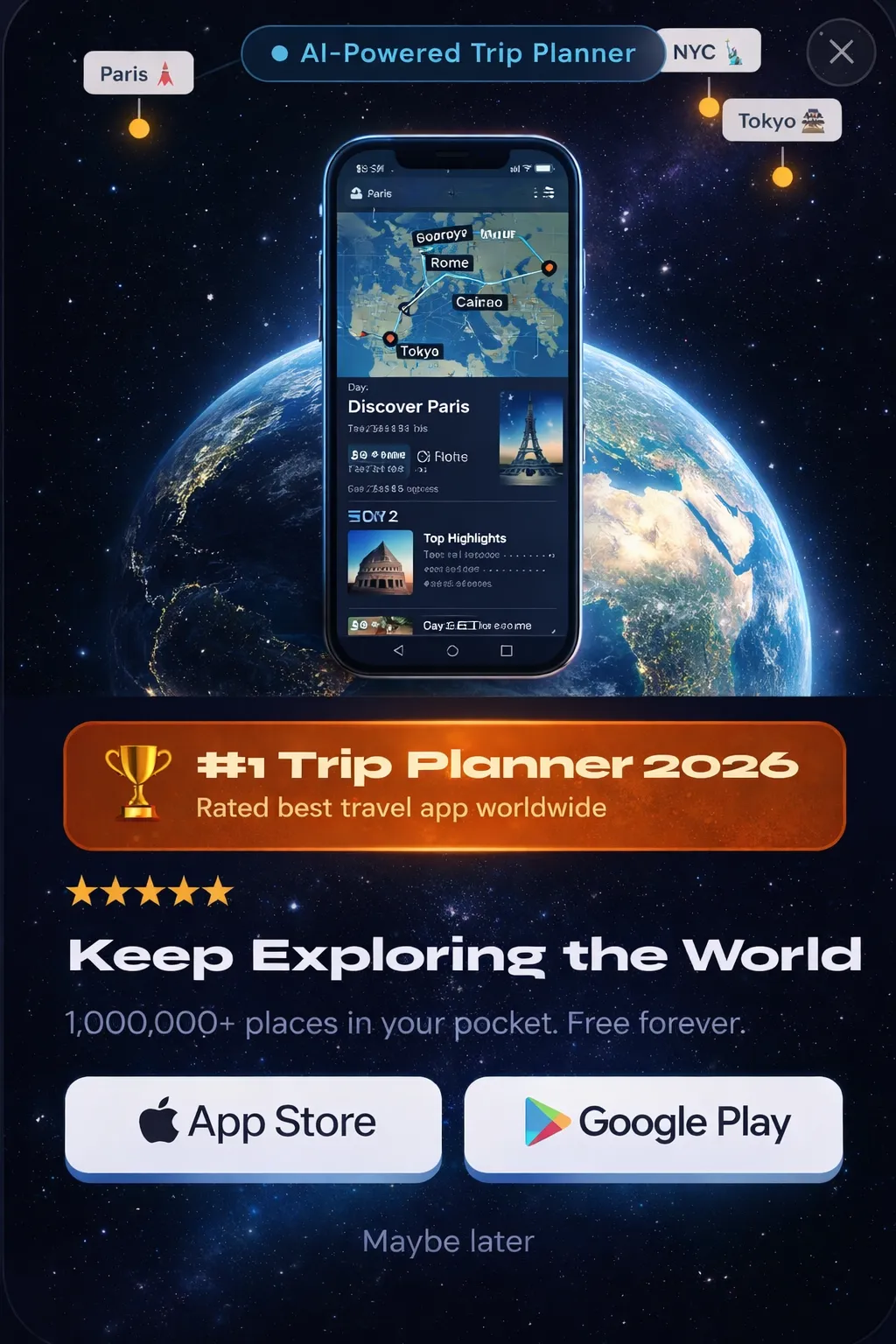
Secret World AI Trip Planner stands out from other apps for one fundamental reason: it doesn't give you a list of attractions, it builds a tailored experience for you. The artificial intelligence engine analyzes your preferences — trip duration, interests, budget, pace — and generates complete and coherent itineraries. For Athens, this means receiving a plan that balances archaeological sites, authentic neighborhoods like Psiri or Koukaki, and day trips to the islands or the Peloponnese, all optimized for real times and distances.
The app's database covers over 1 million destinations worldwide, with a level of detail that includes lesser-known places often overlooked by traditional guides. The integrated audio guides transform the visit into a narrative experience: walking towards the Acropolis while a voice tells the story of the Parthenon is a completely different experience from reading a Wikipedia entry. And then there's the KnowWhere game, an interactive game that challenges the traveler to recognize places and cultures: perfect for preparing before departure or for engaging children during the trip. Secret World is not just a planner — it is a travel companion that knows Athens better than many local guides.
Download Secret World and Plan Your Trip to Athens in 2026
If you are organizing a trip to Athens in 2026 and want to go beyond the Acropolis and the usual tourist circuits, Secret World AI Trip Planner is the tool for you. No other app combines AI-generated itineraries, immersive audio guides, a database of over a million destinations, and a gamification system that makes planning as fun as the trip itself.
Download Secret World for free on the App Store and Google Play, enter Athens as your destination, and let the artificial intelligence build your ideal itinerary — from the temples of the Acropolis to the hidden taverns of Exarchia, to the sunset over the sea at Cape Sounion. Your next trip starts here.