





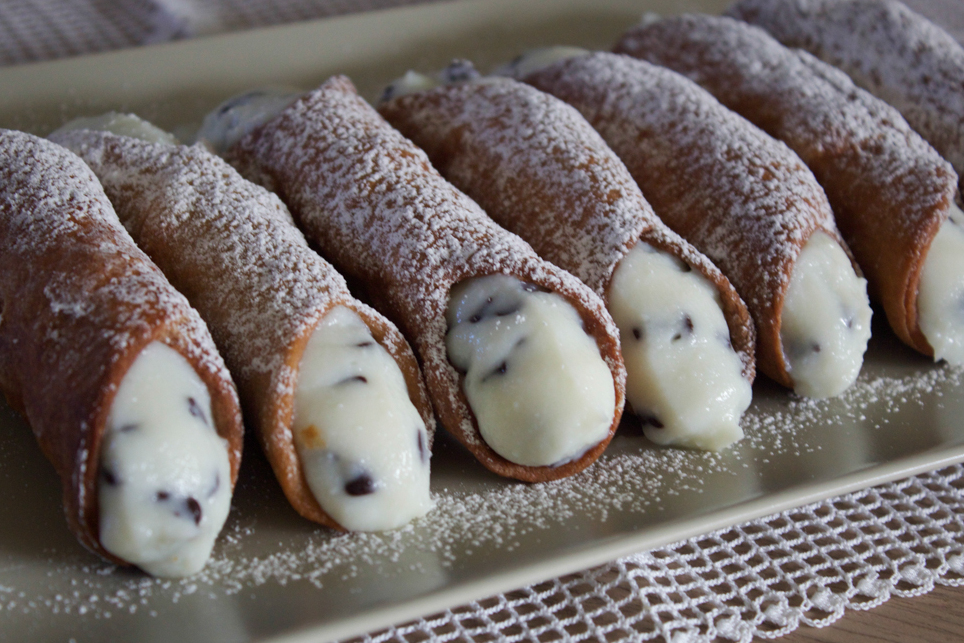
The reference of the name is linked to the river reeds which the wafer was rolled up until a few decades ago during its preparation; according to one hypothesis the cake was invented in ancient times to celebrate the carnival. According to others it has Roman or Saracen origins. The first description dates back to Duke Alberto Denti di Pirajno who in his book Siciliani a tavola writes: "Tubus farinarius dulcissimo edulio ex lacte fartus". According to Pirajno the definition is attributable to Cicero (quaestor of Lilybeo, today's Marsala, between 76 and 75 B.C.). In Michele del Bono's Dictionary: Dizionario di Michele del Bono: Dizionario Siciliano-Italiano-Latino, Palermo 1751, we read verbatim: "Cannola: capelli arricciati. ricci. cincinni [for very thin pasta worked in the shape of a blowtorch, full of white eating. Tubus farinarius dulcissimo edulio ex lacte fartus]", one can clearly see how the lemma in Sicilian corresponds to the definition in Italian and therefore in Latin. Moreover, Pino Correnti, in his Libro d'oro della cucina e dei vini della Sicilia (Golden Book of Sicilian Cuisine and Wines), referring to the above mentioned Latin phrase by De Bono, would only suggest the fact that the definition has been spread for centuries in a description of cannolo in Latin. He also claims that the cannolo was invented by the skilful hands of the cloistered nuns of a convent near Caltanissetta, starting from an ancient Roman recipe later elaborated by the Arabs. According to a widespread tradition, it owes its name to a carnival joke that consisted in making the cream of ricotta cheese come out of the cannolo instead of water, cannolo is a dialectal term that indicates a sort of tap. Although the dessert was born in Caltanissetta, it owes much of its fame and worldwide diffusion to the confectioners of Palermo, who helped to stabilize the recipe, as we know it today, together with the confectioners of Messina, who also invented the variant with dark cream of ricotta and chocolate. of Sicily enclosed in a single dessert ... unmistakable scents and consistencies bite after bite. Sicilian cannoli are a pride of this splendid island, together with cassata, irises, almond pastries... are among the most loved sweets in the world. Served in restaurants as a dessert to be enjoyed in their original format or in mignon version, Sicilian cannoli enchant with their typical bubbles and shimmering ricotta cream from the windows of pastry shops. They attract attention along the streets of Sicilian towns or during events, sold as sweet street food to be stuffed at the moment. Like all regional recipes, there are secrets and versions of Sicilian cannoli that change from city to city or family to family.