
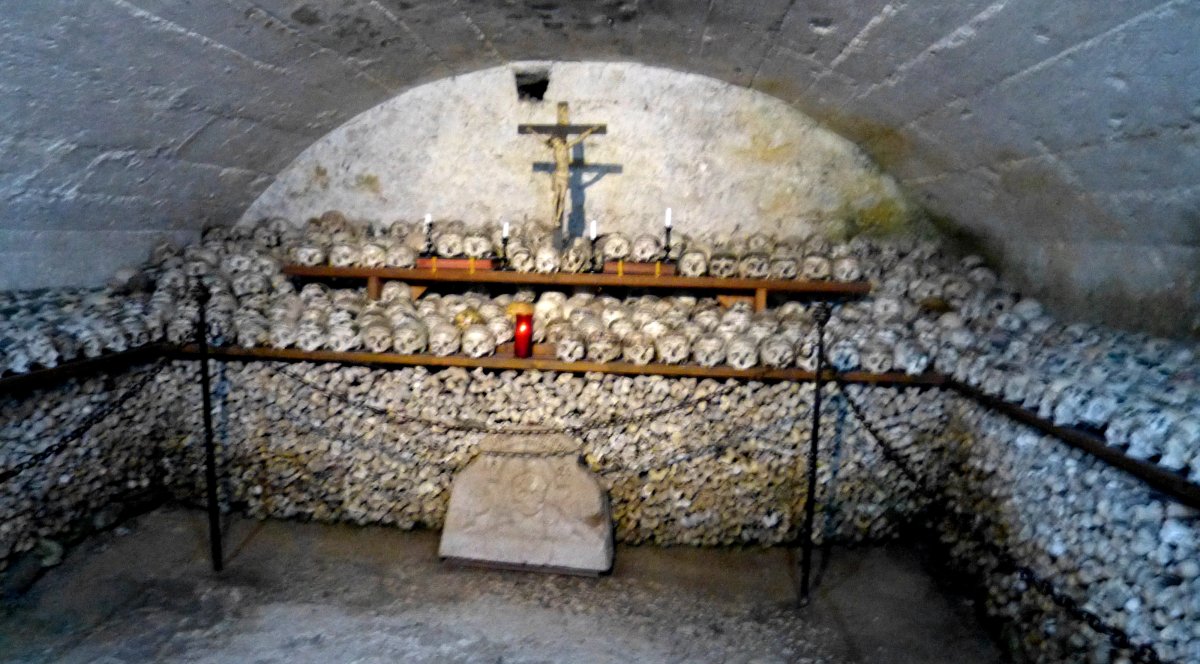
Over 1,200 decorated human skulls rest in an orderly row on wooden shelves, each hand-painted with garlands of roses, ivy, and alpine flowers, and engraved with the name and date of death of the deceased. It is not a movie set nor a contemporary art installation: it is the Beinhaus of Hallstatt, a small ossuary located next to the Chapel of St. Michael, in the cemetery of the Catholic Church of Maria Himmelfahrt, in the heart of one of the most famous lakeside villages in the Austrian Alps.
Hallstatt lies on a narrow strip of land between Lake Hallstätter See and the vertical walls of the Dachstein, in Upper Austria. The physical space of the village has always been tyrannical: the houses climb up the rock, the streets narrow down to alleys, and the cemetery has never had the opportunity to expand. Faced with the impossibility of maintaining burials forever, the local community developed over the centuries a solution that transformed necessity into ritual: after about ten to fifteen years, the bones of the deceased were exhumed, carefully cleaned, and then painted and stored in the ossuary. The tradition dates back at least to the 12th century, although the current structure of the ossuary was consolidated in the subsequent centuries.
The architecture of the ossuary: simplicity and sacredness
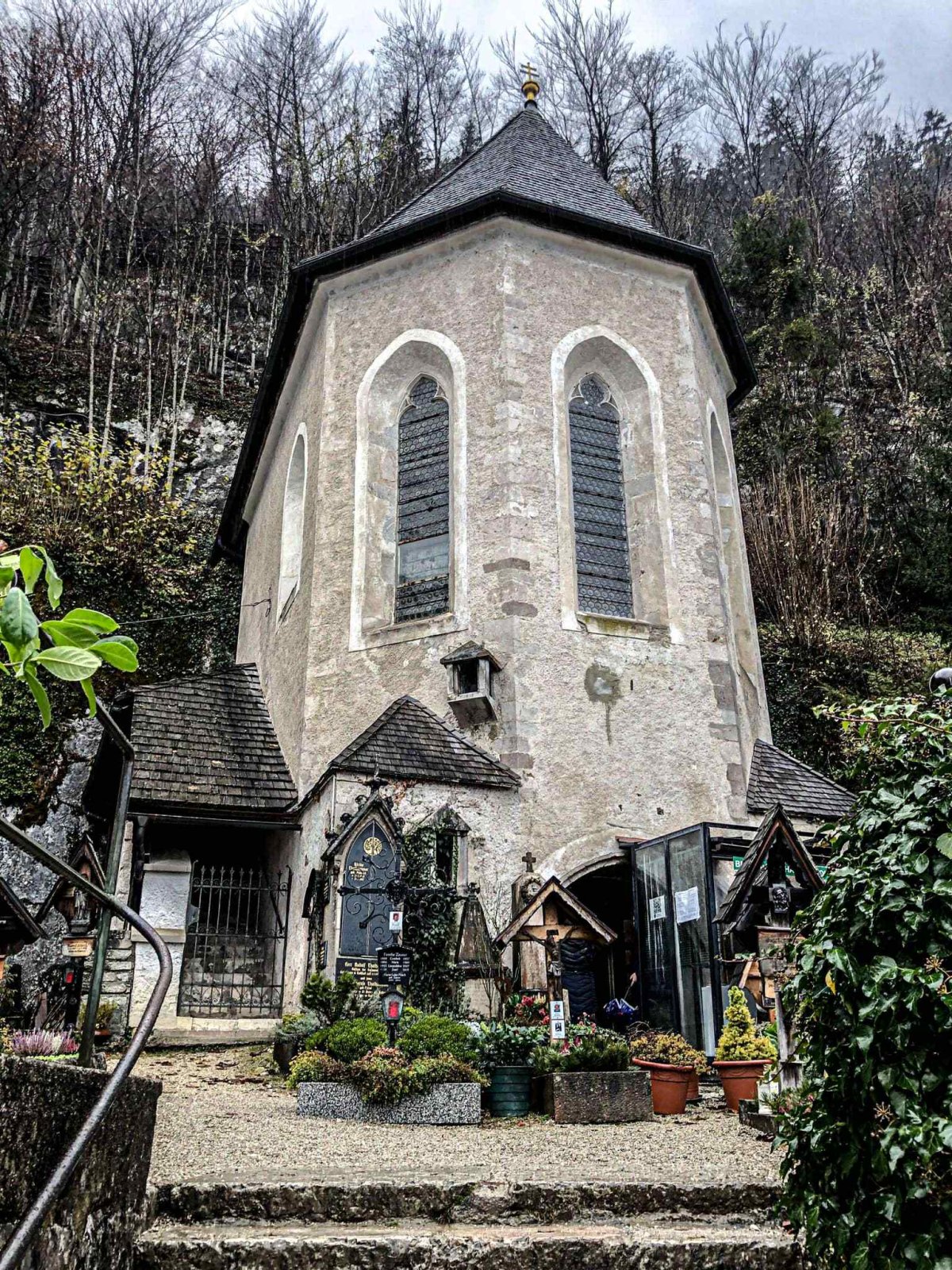
The Beinhaus is not a monumental building. It is a small stone structure attached to the Gothic chapel of St. Michael, with a sober facade that does not hint at what it holds inside. The entrance is modest, almost anonymous, yet crossing that threshold leads into a space that defies all expectations. The walls are covered with shelves on which skulls are arranged in precise ranks, like a silent library. Beneath each skull, the long bones — femurs and tibias — are arranged in a cross, giving the whole a nearly geometric order.
What strikes is not the macabre itself, but the craftsmanship with which each skull has been treated. The floral decorations are painted with fine brushes, often in green, red, and black, with garlands that wrap around the forehead and temples. Many skulls bear the name of the deceased, the family surname, and the year of death. Some also bear religious symbols or crosses. The last skull added to the collection dates back to 1995, belonging to a woman from the village who had expressly requested to be included in the tradition.
The cultural significance of a unique practice
The decoration of skulls was not considered a morbid act by the Hallstatt community, but a gesture of respect and memory. Each family participated in the process: the bones were handed over to local specialized painters, who decorated them according to the family's traditions or the wishes of the deceased. The result is a kind of posthumous portrait, a visual identity that survives the decomposition of the body.
This practice places the Beinhaus within a broader tradition of Alpine and Central European ossuaries, but Hallstatt remains one of the most visited and best-preserved examples. The blend of folk art, religious devotion, and geographical pragmatism creates a place that has no exact equivalents elsewhere. Looking at those skulls means reading centuries of local family history: recurring surnames, overlapping dates, generations accumulating in just a few square meters.
How to visit the Beinhaus: practical tips
The ossuary is open to the public and entry requires a small contribution (generally around 1.50 euros), often to be paid using an honor box system. Opening hours vary seasonally, but normally the site is accessible during daylight hours from April to October. In winter, access may be limited or subject to the schedule of religious services at the adjacent chapel, so it is advisable to check before your visit.
Hallstatt can be reached by train to the Hallstatt station, which is located on the opposite shore of the lake: from there, a ferry takes you directly to the town in a few minutes. Alternatively, you can arrive by car from Bad Ischl or Salzburg. The most useful advice for those wanting to visit the Beinhaus is to choose a morning time during the summer months: Hallstatt is one of the most photographed destinations in Austria and in the afternoons of July and August, the village can be overwhelmed by tourists, making it difficult to experience the visit to the ossuary with the concentration it deserves. Spending at least twenty to thirty minutes inside is enough to observe the pictorial details of the oldest skulls and read the inscriptions, some of which date back to the 18th and 19th centuries.
A place that changes perspective
Leaving the Beinhaus with the same gaze with which one entered is difficult. Not because the place is disturbing — indeed, many visitors describe it as strangely serene — but because it forces one to confront an idea of death treated as continuity, as a visible part of the community of the living. Here the dead do not disappear: they remain, decorated and named, in a room next to the church where their descendants continue to pray. It is an architecture of memory built not with marble or bronze, but with fine brushes and human bones.