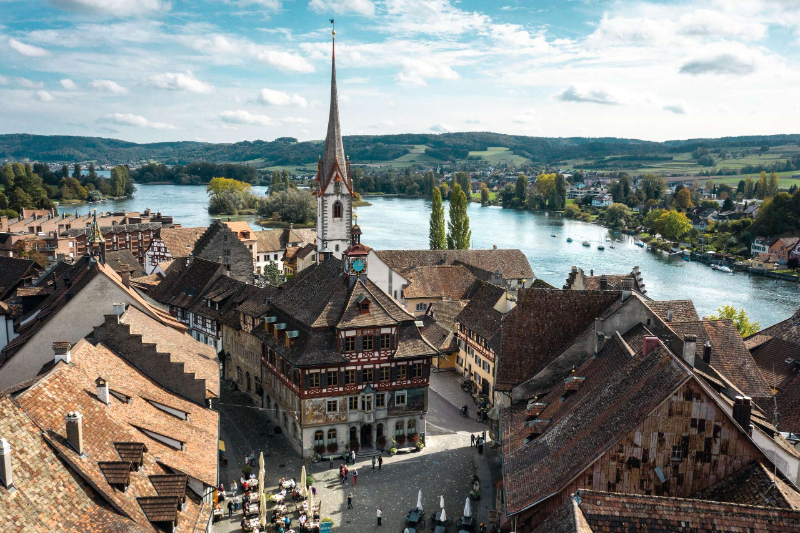

Located on the border between Canton Schaffhausen and Canton Thurgau, Stein am Rhein is described as one of the most beautiful villages in all of Europe.Impossible not to fall in love with Stein am Rhein. This jewel of Canton Schaffhausen lies on the western shore of Lake Constance and overlooks the Rhine River, as suggested by the town's very name ("Stone on the Rhine"). Its history begins in 300, during the Roman Empire at the behest of Emperor Diocletian. We are located along the north bank of the Rhine, almost at the junction with Lake Constance, where the historic core of the town is based. The newer part, on the other hand, is on the opposite side, known as Stein am Rhein vor der Brugg, or in front of the bridge, precisely because of the bridge that connects it to the old town.
The first records in more recent times date back to 1267 while the first town charter was drawn up around 1385. The town obtained the status of Free Imperial City in 1457 and, after two years, joined Zurich and Schaffhausen to counter the continuing attacks of the Habsburgs. Instead, in the 16th century the Swiss town acquired the surrounding territory by joining several small villages, such as Karolihof and Beaver, to the municipality.
Its entry into the Helvetic Confederation took place in 1484, becoming part of the Canton of Zurich, where it remained until 1798 with the transfer to Canton Schaffhausen. It was not an easy and decidedly unpopular choice. The inhabitants strongly protested this choice, which was considered economically risky. Despite riots and various expressions of opposition, the final affiliation with Schaffhausen, as it currently exists, was stipulated in 1803. Walking through the streets of the center, wonderful half-timbered houses decorated with magnificent frescoes loom up. A romantic glimpse with an assured nostalgic effect, as these splendid buildings date from the 13th to 15th centuries. Everything contributes to the fairy-tale atmosphere: the fountains adorned with colorful flowers, the houses with bay windows, and the signs that recall those of classic medieval workshops. The old medieval core is dominated by the imposing Munot fortress, the town's landmark.
Its structure is circular in shape and was built according to a concept by Albrecht Dürer between 1564 and 1589.From its crenellated walls there are extraordinary views.
A curiosity: every evening at 9 p.m., the guard residing in the tower rings the bell, a reminder that it once signaled the closing of the city gates and hotels. Due to its important location between Lake Constance and the Black Forest, on the banks of the Upper Rhine and surrounded by vineyards, the town is a popular destination for holiday stays and excursions.