
← Back

Roman Amphitheatre

Via Roma, 86, 47921 Rimini RN, Italy ★★★★☆ 124 views
Rania Soleil
Rimini
🏆 AI Trip Planner 2026

Get the free app

Discover the best of Rimini with Secret World — the AI trip planner with 1M+ destinations. Get personalized itineraries, hidden gems and local tips. Free on iOS & Android.

🧠 AI Itineraries 🎒 Trip Toolkit 🎮 KnowWhere Game 🎧 Audio Guides 📹 Videos
Scan to download iOS / Android
Scan for AppGallery Huawei users

About Roman Amphitheatre

Roman Amphitheatre - Rimini | Secret World Trip Planner

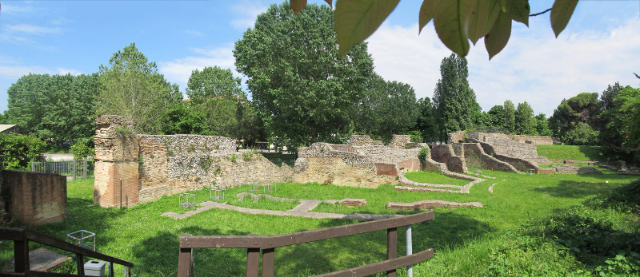
Together with Arco d'Augusto and the Ponte di Tiberio, this completes the triad of the city's main monuments dating from Roman times. Built under Hadrian in the 2nd century AD, as demonstrated by the discovery of a coin bearing the effigy of the Emperor in some masonry, it was uncovered following excavations in 1843-44, which were followed by the more important ones of 1926 and 1935.

What survives demonstrates that the amphitheatre in Rimini was certainly one of the most imposing in the region, as well as being the only one to partially survive in Emilia Romagna. The brick structure is elliptical in shape, with its main axis measuring 118 m and the smaller one 88 m; it consisted of four concentric rings with an overall thickness of 21,80 m. The size of the elliptical arena (73,76 m and 44,52 m) made it similar to that of the Coliseum. It was 16-17 m high and its external portico had 60 arches; two are still visible, incorporated into the walls when the city gave itself a new ring of defences against the Barbarian invasions. In the Middle Ages, it was used as allotments and in the 17th century as a lazaretto. It suffered the most serious damage during WWII. Of the great complex, which could originally accomodate up to 12,000 spectators, you can still see the two arches of the esternal portico and part of the arena and the cavea.


🗺 L'app dei tesori italiani

Plan your visit to Rimini

Suggested itinerary near Roman Amphitheatre

MAJ+
500.000+ travelers worldwide
  1. 🌅
    Morning
    Roman Amphitheatre
    📍 Rimini
  2. ☀️
    Afternoon
    Rimini and the Fellini Museum
    📍 0.3 km · Rimini
  3. 🌆
    Evening
    Malatesta Temple
    📍 0.4 km · Rimini

Buy Unique Travel Experiences

Powered by Viator

See more on Viator.com

Explore nearby · Rimini

Frequently Asked Questions

The amphitheatre was built under Emperor Hadrian in the 2nd century AD, as confirmed by the discovery of a coin bearing his effigy in the masonry. It was excavated and uncovered during archaeological digs in 1843-44, with more significant excavations conducted in 1926 and 1935.
The Rimini amphitheatre was one of the most imposing in the region and remains the only one to partially survive in Emilia Romagna. Its elliptical arena measured 73.76 m by 44.52 m, making it similar in size to the famous Coliseum, and could originally accommodate up to 12,000 spectators.
The surviving remains include two visible arches of the external portico, parts of the arena, and sections of the cavea (seating area). The structure was originally 16-17 meters high with an elliptical brick design measuring 118 m on its main axis and 88 m on the smaller one, consisting of four concentric rings.
During the Middle Ages, the amphitheatre was converted into agricultural allotments, and in the 17th century it served as a lazaretto (quarantine hospital). Two of its arches were incorporated into the city's medieval defensive walls built against Barbarian invasions, and the structure suffered significant damage during World War II.
The amphitheatre completes a triad of the city's main Roman monuments, alongside the Arco d'Augusto and the Ponte di Tiberio, making it essential for understanding Rimini's rich Roman heritage. These three structures together showcase the city's importance during the Roman Empire period.