





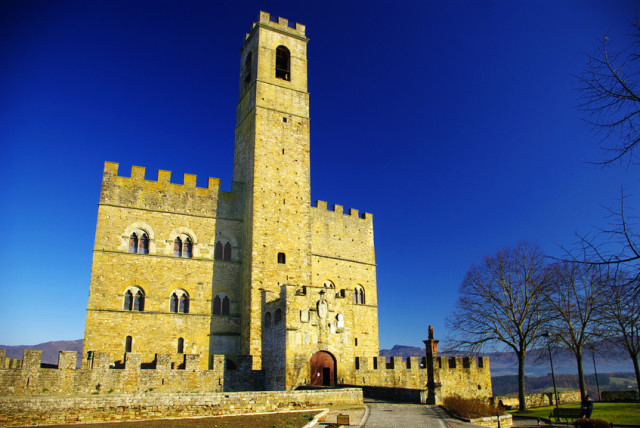
The earliest records of Poppi's fortified site date from 1191, but it is believed to have been built between the 9th and 10th centuries following the breakup of the Carolingian Empire.

Since its origins, the castle's history has been closely linked to that of the largest feudal family in Casentino, which placed Poppi at the center of its large estates and inhabited this manor for nearly four hundred years: the Conti Guidi.
The present architecture is attributed by historians to 1274, a period when Count Simone di Battifolle was in power and who had the right side of the building built, commissioning it from the architect Lapo di Cambio. The castle bears a certain resemblance to the Palazzo Vecchio in Florence, later built by Arnolfo di Cambio, so much so that it is mentioned by Vasari in his work "Lives of the most excellent architects, sculptors and painters," when he describes its construction, and deserves the definition by some experts of "Prototype" of the Florentine palace.
The few openings in the masonry surrounding the castle appear to be original. The fortified walled enclosure was then built around the tower from which the other buildings of the fortification developed.
The complex had only two gates, a larger one facing downstream toward Ponte a Poppi with a steep ramp, and a smaller one on the opposite side toward the parade ground. After the last major renovation of the castle in 1470 it was the latter, with the name Porta del Leone (Lion's Gate), that became its main access. That gate owes its name to a bas-relief depicting a large lion, made by Baldassarre Turriani (1477), placed just above its opening.
The castle was expanded with the construction of the rectangular block placed on the right of the tower. This was the primitive structure of the Castle, used from the lower floors upwards as a prison, storage, and living quarters, respectively. Although today it is joined to the tower by a curtain wall, originally the two buildings were detached, connected only by drawbridges on the upper floors, to be each independent and eventually in defense of the other. In the upper floor hall of the keep, now the site of town council meetings, the surrender of the last of the Guidi counts, Francesco, to the Florentine Republic was drawn up in 1440.
Almost at the same time the construction of the other wing of the castle, on the opposite side from the tower, was also begun. Inside which was created the inner courtyard that we still admire today, full of stone coats of arms of the Florentine families who carried out the vicariate to the castle.
Another major intervention was carried out from 1470: it mainly affected the inner courtyard with the construction of the splendid stone staircase for access to the various floors of the building and the outer enclosure. The ditch separating the Castle from the parade ground was dug, and on the outer enclosure was erected the anti-gate known as the "Munition," in defense of the Lion Gate. The Munition was also equipped with a drawbridge, which has now disappeared. The Castle was now a splendid residential palace.
The latest restoration, which dates back to the last century, with the rebuilding of most of the battlements and the restoration of the mullioned windows and other parts of the masonry, gave the Castle its splendid present appearance.
A curiosity that embellishes the history of the Castle is related to Dante Alighieri, who stayed there in the years between 1307 and 1311, and tradition has it that it was in Poppi that the supreme poet composed the XXXIII canto of the Inferno of his "Comedy."
Dante Alighieri himself took part in the celebrated Battle of Campaldino, fought between Guelphs and Ghibellines not far from the Conti Guidi Castle.
THE BATTLE.
The Battle of Campaldino, which was fought not far from the Castle of the Conti Guidi on Saturday, June 11, 1289, St. Barnabas Day, between the Guelph army of Florence and the Aretine militia supported by the Ghibelline feudalty of central-southern Tuscany, is one of the very few large-scale pitched battles fought throughout the Middle Ages in central Italy.
Warfare in the Middle Ages, contrary to what many believe, was very rarely the affair of large-scale pitched battles and was instead small-scale warfare, consisting of raids, pillaging, blows, and the destruction of crops (so-called cavalry) in order to weaken the enemy economically.
The phenomenon is clearly explicable. The population size of Italian cities was not such that the communes could form, equip and send large armies into combat, and this is even more true of the feudal militias that the lords of the countryside opposed to city expansion.
The Battle of Campaldino is an exception to this pattern, since the fighting sides were able to field nearly 20,000 men. The city had mobilized all its military resources, offering a clear picture of how a communal army moved, deployed and fought in the late 13th century.
Leading the Florentine army, reinforced by units from many Guelph Tuscan cities, was the Provençal Amerigo of Narbona flanked in the field by the knight Guillaume de Durfort, while the ranks of Arezzo were arrayed under the banners of Guglielmino degli Ubertini, bishop of Arezzo, along with those of Bonconte da Montefeltro and other Ghibellines of Tuscany. The aim of the Florentines was to reach Arezzo through the Casentino, instead of from the Valdarno, so as to take the Ghibelline ranks by surprise. The battle was bloody, half the Arezzo army fell on the field, including Bonconte, Bishop Ubertini, and the standard-bearer of the Empire, Count Percivalle, and many were the prisoners taken to Florence.
This battle, fought with a strategy new to military clashes at the time, quickly became a symbol in the collective imagination of the Tuscans.
Precisely because of its exceptional nature, this fact of arms is therefore valuable for studying and understanding the military instrument and organization of a great city like Florence, at the height of its communal phase.