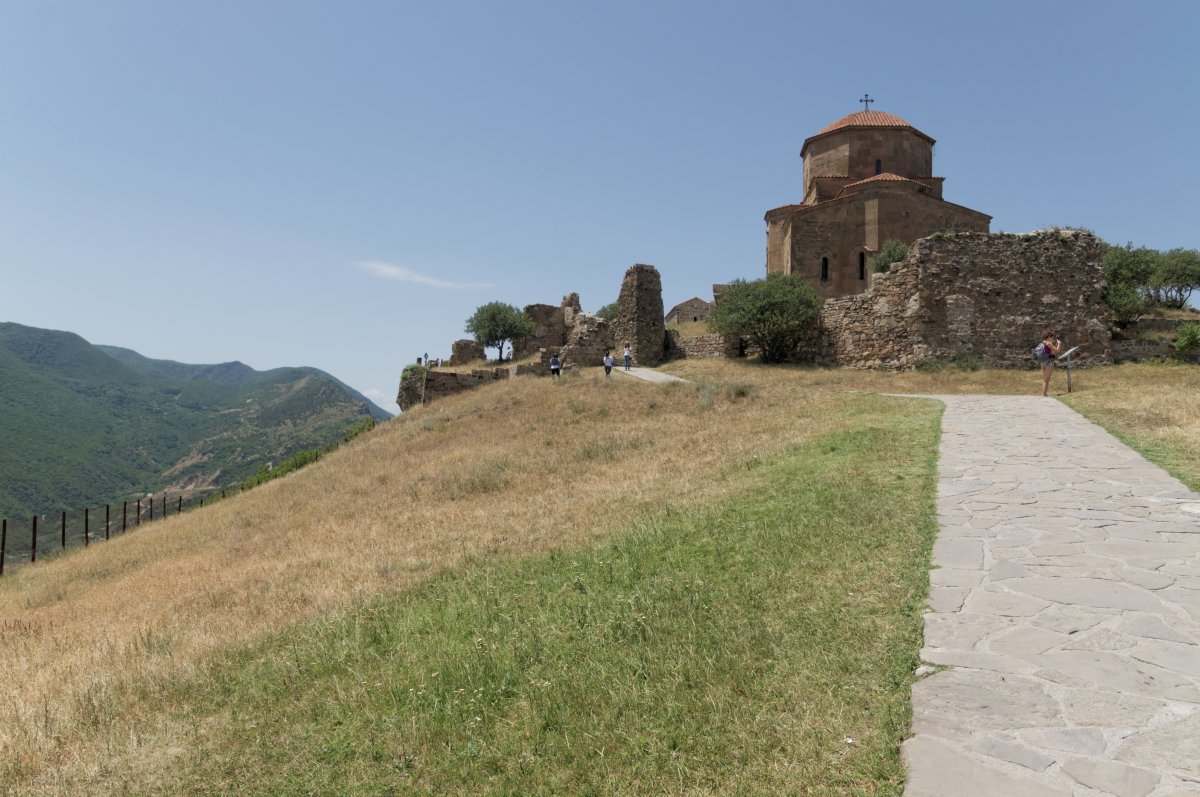

When the sun sets behind the hills surrounding Mtskheta, the waters of the Mtkvari and Aragvi turn a burnt orange. From up here, from the stone platform of the Jvari Monastery, you can clearly see the exact point where the two rivers meet, a confluence that Georgians call santslisi and which has been considered sacred for centuries. It is not a metaphor: it is a visible, concrete geometry that draws itself beneath your feet every evening.
Jvari means cross in Georgian, and the name recalls the tradition that here, in the 4th century, Saint Nino had a wooden cross erected at the highest point of the hill overlooking the ancient capital Mtskheta. The stone church that is visited today was built between the end of the 6th and the beginning of the 7th century, probably completed around 605 AD, during the reign of the princes Stepanoz I and Adarnase. It is one of the best-preserved examples of late antique Georgian ecclesiastical architecture, with a cross plan inscribed in an octagon that has influenced generations of builders in the Caucasus.
What to see inside the church
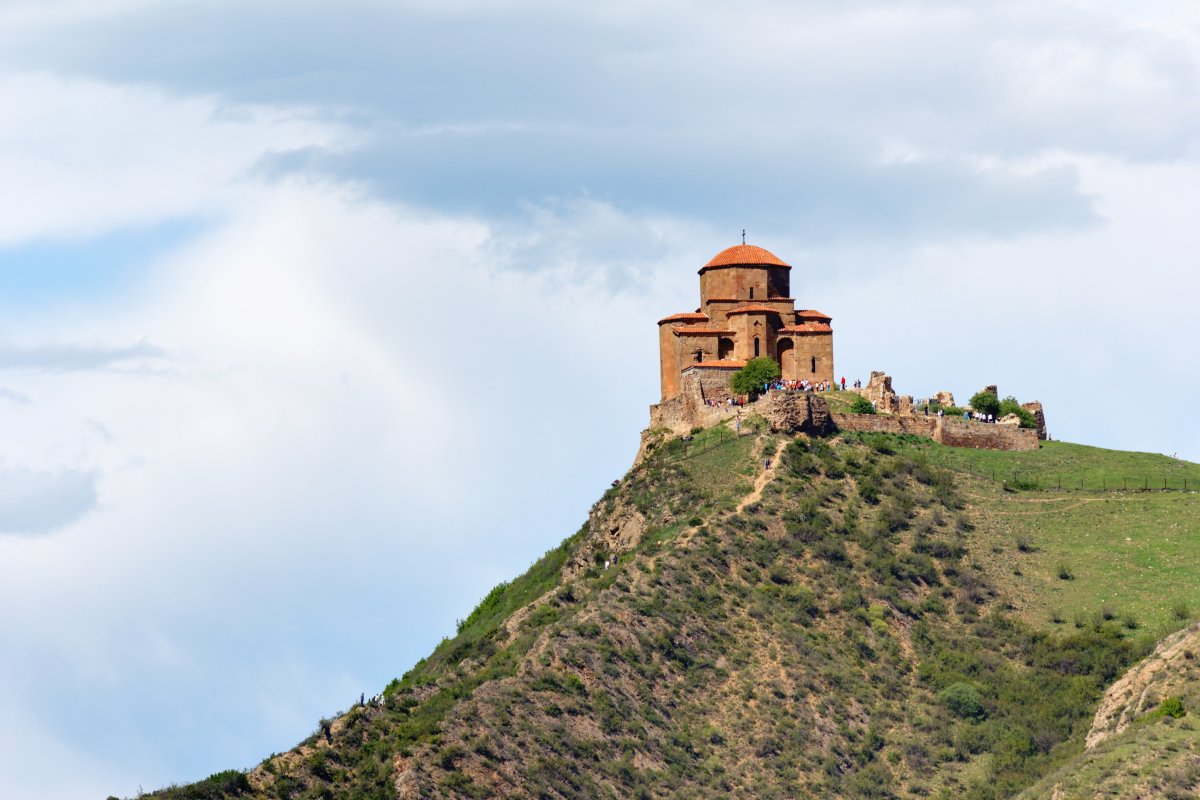
The exterior of Jvari impresses with its simplicity: the walls made of local sandstone display carved reliefs depicting princely donors, still legible despite centuries of weathering. Inside, the space is small and almost bare. In the center of the nave stands the stone base that, according to tradition, marks the spot where Saint Nino planted her cross. The walls bear traces of medieval frescoes, faded but still present in some areas.
The light filtering through the narrow windows changes radically throughout the day. In the late afternoon, when the sun is low, it enters at an angle and illuminates the stone with a warm hue that is not visible in photographs. It is one of those details that can only be understood by standing still for a few minutes in silence, something that is possible here even in the presence of other visitors, as the church naturally invites tranquility.
The sunset over the confluence of the rivers
The most extraordinary moment at Jvari is not inside the church, but outside, on the edge of the hill. The panoramic platform to the east of the church offers a direct view of the confluence of the Mtkvari (also known as Kura) and the Aragvi. The two rivers have different colors for much of the year: the Mtkvari tends towards green-gray, the Aragvi towards lighter blue, and the line where they meet is visible to the naked eye from above.
At sunset, this distinction dissolves into gold. The last rays of light make both surfaces shine with the same intensity, and the city of Mtskheta, with its churches and rooftops, stands out darkly against the light. The Russian poet Mikhail Lermontov described this very scene in his poem The Mtsyri (1840), set right in Mtskheta, and the confluence of the rivers is one of the central elements of the text. Reading those lines before coming here adds a layer of meaning to the view.
How to get there and when to go
Jvari is located about 20 kilometers from Tbilisi, the capital of Georgia. The most common route starts from Mtskheta, which can be reached by marshrutka (minibus) from the Didube bus station in Tbilisi in about 30 minutes. From Mtskheta, the hill of Jvari can be reached by taxi or private car: the paved road leads up to the parking area near the church. There is no direct public transport service to the top.
Entry to the monastery is free, but it is active as a place of worship, so respectful clothing is required: shoulders covered and, for women, head covered inside. The average visit time is 45 minutes to an hour, but those who want to enjoy the sunset should arrive at least 30-40 minutes before sunset and bring something to keep warm: the hill is exposed to the wind even in summer, and the temperature drops quickly after sunset.
Why it is worth stopping here
Mtskheta has been a UNESCO heritage site since 1994, and Jvari is one of the sites included in the recognition along with the Cathedral of Svetitskhoveli, which is clearly visible from the hill below. But Jvari has something that more frequented sites often lose: a human scale. The church is small, the hill is narrow, the silence is real. There are no souvenir shops stuck to the walls, there is no ticket office with queues.
What remains, after the visit, is the precise image of the two rivers merging at twilight, and the feeling of having seen something that has existed for fourteen centuries and will continue to exist regardless of who passes by to look at it. That is enough.