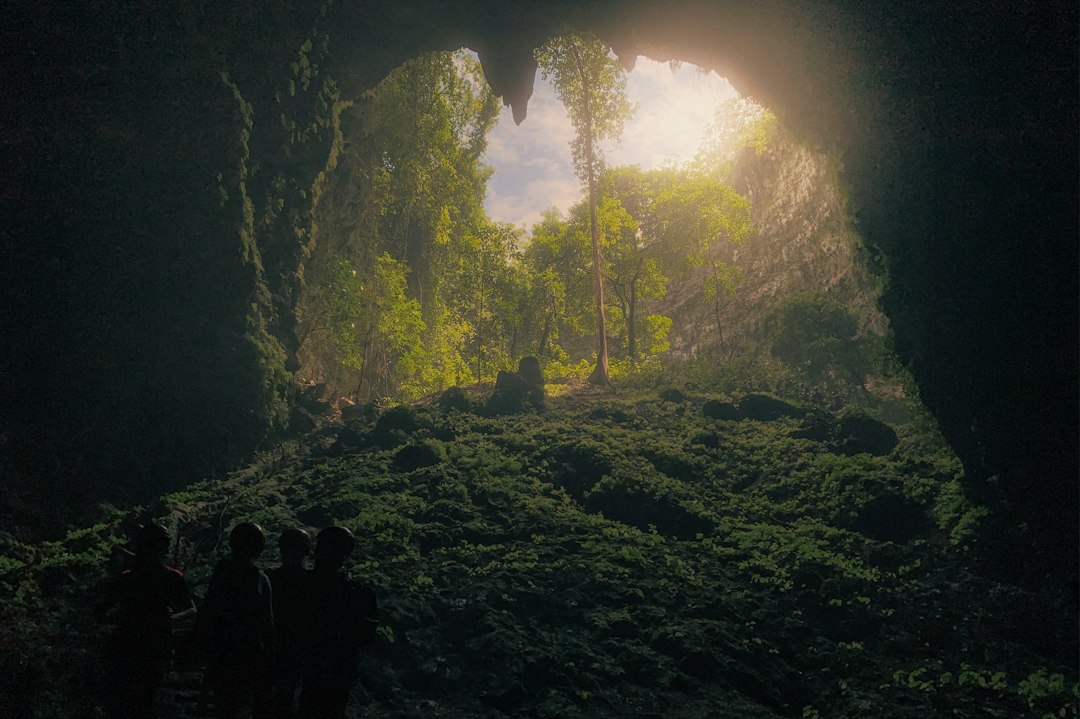

One rope, the void beneath the feet and then, slowly, the descent into a world that does not seem to belong to our time. The Jomblang Cave, located in the Semanu district in the Gunungkidul region, about 40 kilometers southeast of Yogyakarta, is a type of collapsed sinkhole: the ceiling of an underground chamber collapsed millennia ago, creating a vertical opening of about 50 meters in diameter that plunges over 60 meters into the ground. At the bottom of this natural abyss, protected from darkness and constant humidity, a prehistoric forest has survived that does not receive direct sunlight except for a few minutes every morning.
That moment — called by locals and visitors from around the world "light from the sky" — is the heart of the Jomblang experience. A beam of sunlight penetrates through the opening at the top of the sinkhole, traverses dozens of meters of absolute darkness, and illuminates the floor of the adjacent cave, the Grubug Cave, with an almost theatrical precision. It does not last long: it depends on the season, the clouds, the angle of the sun. But when it happens, the scene is of a visual power that is difficult to describe with ordinary words.
How this natural phenomenon forms
The Jomblang Cave was formed through a geological process called karst dissolution, typical of the Gunungkidul plateau, a region of central Java predominantly composed of limestone. Over thousands of years, rainwater, slightly acidic due to absorbed carbon dioxide, has slowly eroded the rock from the inside, creating increasingly larger empty chambers. When the ceiling of one of these chambers could no longer support its weight, it collapsed downward, generating the vertical opening that visitors now descend with ropes.
At the bottom of the sinkhole, about 60 meters deep, there is vegetation that botanists classify as relict: plants that thrive in conditions of minimal light, extremely high humidity, and constant temperature, in a microclimate that resembles much older environments. From here, access is gained to a horizontal corridor that leads to the Grubug Cave, where the floor is covered in guano and where, at the right moment in the morning, a beam of light strikes with an almost supernatural force.
The descent experience: what to expect
A visit to the Jomblang Cave is not an excursion for those seeking comfort. Visitors are equipped with harnesses, helmets, and gloves, and descend vertically along a rope secured by experienced local guides. The descent into the sinkhole takes a few minutes and, even for those who do not suffer from vertigo, requires a moment of adjustment: the emptiness around is real, the walls covered in roots and moss slide past the body, and the air gradually becomes cooler and more humid.
Once at the bottom, you walk through the prehistoric forest — a stretch of a few minutes on uneven ground — before entering the corridor that leads to the Grubug Cave. Artificial lighting is kept to a minimum, and the guides turn off the flashlights at key moments to allow the darkness to be total before the beam of light appears. The entire visit lasts on average between 3 and 4 hours, including the descent, the stay in the cave, and the ascent using a pulley system.
Practical information for organizing the visit
Access to the Jomblang Cave is regulated and requires advance booking, as the daily number of visitors is limited for safety and environmental conservation reasons. Tours generally depart in the early morning — usually between 8:00 and 9:00 — precisely to synchronize the stay in the cave with the moment when the sun is in the right position to generate the light beam. Arriving late almost certainly means missing the main phenomenon.
The entrance fee, which includes equipment and a guide, is approximately around 450,000-500,000 Indonesian rupiah per person, an amount subject to seasonal variations and depending on the chosen operator. It is strongly recommended to book through certified local agencies in Yogyakarta or directly through operators recognized by the local government of Gunungkidul. Wearing non-slip sole shoes is essential: the cave floor is muddy and slippery in any season. Avoid visiting during the peak rainy season — typically between November and January — when conditions inside can become dangerous due to rising water levels.
Why the trip is worth it
Jomblang is not a cave that is visited for its stalactites or for its dimensional records. Its strength lies in the overall experience: the physicality of the descent, the absolute silence at the bottom, the smell of damp earth and dense vegetation, and then that beam of light that transforms for a moment a dark and claustrophobic environment into something that resembles a vision. It is not rhetoric: it is a matter of physics and timing, and it works precisely because it is real.
For those traveling to Yogyakarta and who have already visited Borobudur or the Kraton, Jomblang offers a completely different kind of wonder, more physical and more intimate. It is a place that requires a certain effort to be reached and experienced, but that gives back something difficult to find elsewhere: the concrete feeling of having entered the earth and having seen, for a moment, the world from the inside.