Beyond a dark wooden gate, hidden among the wooded hills in the heart of Seoul, lies a world that has remained invisible to common eyes for centuries. The Huwon — literally "rear garden" — of Changdeokgung Palace spans about 32 hectares (78 acres) of forests, lotus ponds, and lacquered wooden pavilions, and for centuries it was the private refuge of the kings of the Joseon dynasty. It is not an ornamental garden in the European sense: no rigid symmetry, no baroque fountain. Here, nature has been guided with a light hand, allowing hills, trees, and water to dictate the shape of the spaces.

Changdeokgung Palace was built in 1405 as a secondary residence for the royal family, and in 1997 it was inscribed on the UNESCO World Heritage List, a recognition that highlighted the exceptional value of its harmonious relationship with the surrounding natural landscape. The Huwon is not freely accessible: visitors can only enter with guided tours at fixed times, which helps preserve an atmosphere of authentic tranquility that, in a metropolis of ten million inhabitants, is almost impossible to find elsewhere.
A landscape built for contemplation

The visual centerpiece of the Huwon is the Buyongji, a rectangular pond artificially excavated in 1707 during the reign of King Sukjong. At the center of the water rises a small circular island: the shape is deliberate and symbolic — the square land supporting the round sky, according to Confucian cosmology. On the shores of the pond stand two main pavilions: the Buyongjeong, cross-shaped, with pillars resting directly in the water, and the Juhamnu, a two-story royal library that housed thousands of volumes. Observing the Buyongjeong up close, one can notice how the reflections in the water create a mirror effect that visually doubles the structure: a detail that the Joseon kings appreciated in the morning hours, when the light is more slanting.
Deeper in the woods are other ponds and smaller pavilions, scattered along paths that rise among oaks and maples. In autumn, when the foliage turns to orange and red, the colors reflect in the still water of the ponds with a chromatic effect that alone justifies the trip. This is not rhetoric: it is one of the reasons why reservations in October and November sell out weeks in advance.

The story that is read in the buildings
The Changdeokgung Palace and its garden have traversed centuries of Korean history, including destruction during the Japanese invasion of 1592 and subsequent reconstruction. Some of the current buildings date back to the 17th century, rebuilt using traditional techniques that utilize wood, stone, and gray tiles in a balance that has not changed over the centuries. The Nakseonjae, a residential complex within the palace perimeter, was inhabited until 1989 by members of the royal family: it is one of the few places in Korea where the continuity between history and real life can be accurately documented.
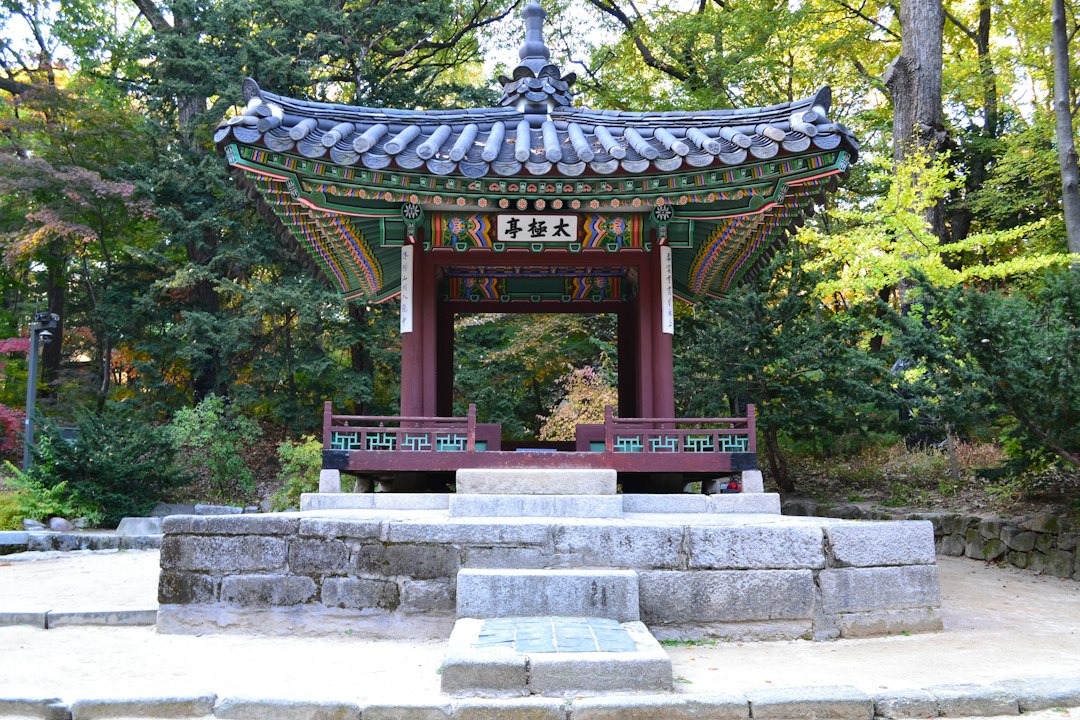
Walking among the pavilions, one observes details that restorations have carefully preserved: the beams painted with geometric and floral patterns in green, red, and blue — the decorative technique called dancheong — protected the wood from moisture and signaled the status of the buildings. The royal pavilions have more elaborate decorations compared to those intended for scholars or officials: a hierarchy still visible today to the naked eye.
Practical Information for the Visit

Access to the Huwon is allowed only with guided tours, available in Korean, English, Chinese, and Japanese. The ticket for the foreign language tour costs about 8,000 Korean won (just over 5 euros), and the visit lasts about 90 minutes. Spots are limited and online reservations sell out quickly, especially on weekends and during the autumn foliage: it is advisable to book on the official palace website at least a week in advance.
The palace is easily reachable by the Seoul subway: the nearest station is Anguk on line 3, from which it is about a ten-minute walk. The best time to visit is early in the morning, when the light filters through the trees and the groups of tourists are still small. Avoid Mondays, which is a closing day. Wearing comfortable shoes is essential: the garden paths go through slopes on uneven terrain, and the beauty of the place is appreciated by walking slowly, not in a hurry.