
← Back

Holy Trinity Cathedral

30a Abercromby St, Port of Spain, Trinidad e Tobago ★★★★☆ 399 views
Ana Morales
Port of Spain
🏆 AI Trip Planner 2026

Get the free app

Discover the best of Port of Spain with Secret World — the AI trip planner with 1M+ destinations. Get personalized itineraries, hidden gems and local tips. Free on iOS & Android.

🧠 AI Itineraries 🎒 Trip Toolkit 🎮 KnowWhere Game 🎧 Audio Guides 📹 Videos
Scan to download iOS / Android
Scan for AppGallery Huawei users

About Holy Trinity Cathedral

Holy Trinity Cathedral - Port of Spain | Secret World Trip Planner

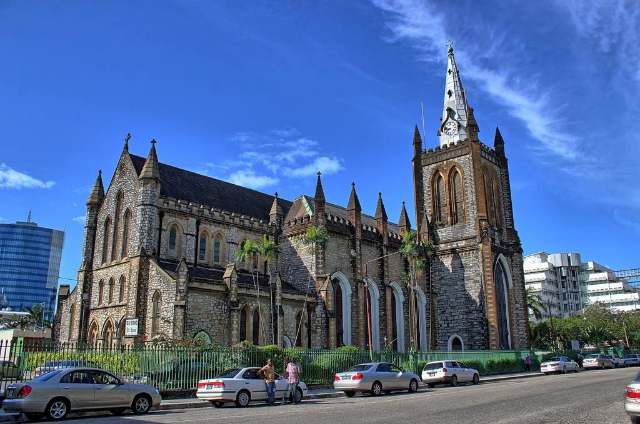
Holy Trinity Cathedral is one of the oldest structures in Port of Spain, built between 1816 and 1823, it is still the center of the Anglican Church in Trinidad and Tobago. Its construction was decided in Britain in order to strengthen the Anglican Church in the West Indies and as a means of Anglicizing Trinidad's predominantly Catholic population after the island was conquered by the British in 1797. It originally served as a place of worship for the British elite in Trinidad and as the seat of the Anglican Bishop of the Diocese of Trinidad.The Cathedral was built using elements of the Gothic Revival movement, which began in the late 1740s in England. As a result, the Cathedral features lancet windows, pinnacle buttresses, a steeply pitched roof, and a strong emphasis on height. Materials used for construction include blue limestone from the Laventille quarries and yellow bricks imported from England.The property is located in the city of Port of Spain, bounded on the north by Hart Street, on the south by Queen Street (now known as Queen Janelle Commissiong Street), on the east by Frederick Street, and on the west by Abercromby Street.Holy Trinity Cathedral has witnessed important events in the history of Trinidad and Tobago. In 1824, during an official visit by Brazilian Emperor Dom Pedro I, two side galleries were built to accommodate the imperial procession. The cathedral also suffered damage during the 1906 earthquake and was later restored. In 1962, the cathedral hosted the opening ceremony of Trinidad and Tobago's independence, marking an important event in the country's history.Holy Trinity Cathedral is open to the public for sightseeing and religious ceremonies. The facility also hosts cultural and musical events and is an important landmark in the city of Port of Spain.


Holy Trinity Cathedral - Port of Spain | Secret World Trip Planner

Buy Unique Travel Experiences

Powered by Viator

See more on Viator.com

Frequently Asked Questions

Holy Trinity Cathedral was constructed between 1816 and 1823 after the British decision made in Britain to strengthen the Anglican Church in the West Indies and Anglicize Trinidad's predominantly Catholic population following the island's conquest in 1797. It originally served as a place of worship for the British elite and as the seat of the Anglican Bishop of the Diocese of Trinidad.
The cathedral features Gothic Revival architecture, which includes lancet windows, pinnacle buttresses, a steeply pitched roof, and strong emphasis on height. The structure was built using blue limestone from the Laventille quarries and yellow bricks imported from England, giving it its distinctive appearance.
Holy Trinity Cathedral is situated in the heart of Port of Spain, bounded by Hart Street on the north, Queen Janelle Commissiong Street (formerly Queen Street) on the south, Frederick Street on the east, and Abercromby Street on the west. This central location makes it easily accessible for visitors exploring the city.
The cathedral hosted several significant events including an official visit by Brazilian Emperor Dom Pedro I in 1824, when side galleries were built to accommodate his imperial procession. Most notably, it hosted the opening ceremony of Trinidad and Tobago's independence in 1962, and it survived the 1906 earthquake with subsequent restoration.
Yes, Holy Trinity Cathedral is open to the public for sightseeing and religious ceremonies, and it welcomes visitors interested in experiencing its historic architecture and religious significance. The facility also hosts cultural and musical events, making it not only a religious center but an important cultural landmark in Port of Spain.