10 Best Things to Do in Rome, Italy — beyond the obvious
A long-term resident's guide to the city that refuses to be summarised
L
Una guida di
Lena Hofmann
Aggiornata il
7 ottobre 2026
Lettura
13 minuti
Comprende
10 luoghi · mappa interattiva
★ Guida d'Italia 2026
Pianifica con cura. Viaggia più a fondo.
1.3M+ luoghi curati nel mondo, mappe offline e itinerari intelligenti — tutto in un'app gratuita.
1.3M+ luoghiMappe offlineItinerari AIGratis
The first time I came to Rome with any serious intention of understanding it, I spent three days doing exactly what you're not supposed to do. I queued for the Colosseum in August heat, ate a mediocre carbonara within sight of the Trevi Fountain, and photographed the Spanish Steps from an angle that ten million other people had already photographed. I was, in other words, processing Rome rather than experiencing it. The city permitted this. Rome is patient with tourists in the way that a large, old dog is patient with children — tolerant, slightly bored, occasionally capable of a slow bite.
What I've come to understand, after many subsequent visits and one extended stay that stretched from a planned three weeks into nearly four months, is that Rome doesn't reward itinerary-following. It rewards loitering. It rewards the wrong turn, the closed door that turns out to be open, the bar where nobody speaks English and the espresso costs ninety cents. The city is stratified in a way that no other European capital quite matches — you can be standing on a medieval street, above a Roman sewer, beside a Renaissance fountain, looking at a Baroque church facade, while a 2019 Fiat honks at a delivery scooter. The layers don't cancel each other out. They accumulate.
This list is not the Colosseum. It is not the Vatican Museums or the Sistine Chapel, which you should see, but which you will find described with more logistical precision elsewhere. What follows instead is a set of places that I've returned to more than once, that have surprised me, confused me, or simply given me somewhere to stand and think. A few of them are genuinely obscure. Most are not. But all of them are worth your time in a way that the queues outside them — where they exist — do not always suggest.
Most visitors walk past the Fontana della Pigna without registering it as a destination in its own right, which is precisely why it rewards a deliberate stop. The fountain — a simple, elegant stem rising from a shallow basin, with two stylised tulip corollas supporting a bronze pine cone at its apex — sits in the courtyard of the Palazzo della Pigna, a few minutes' walk from the Pantheon. Water issues from two small channels in a way that feels almost apologetic, as if the fountain is aware it cannot compete with the baroque theatrics elsewhere in the city. The pine cone itself is a reproduction; the ancient original, a massive bronze artifact from the first or second century AD, spent centuries in the atrium of Old St. Peter's Basilica before being moved to the Vatican. This smaller, quieter version carries none of that prestige, which is perhaps why it feels more genuinely Roman — functional, a little worn, uninterested in impressing you.
Il consiglio del team
The courtyard is easy to miss because the entrance is narrow and unmarked on most maps. Come in the late morning before the lunch crowds thicken the surrounding streets.
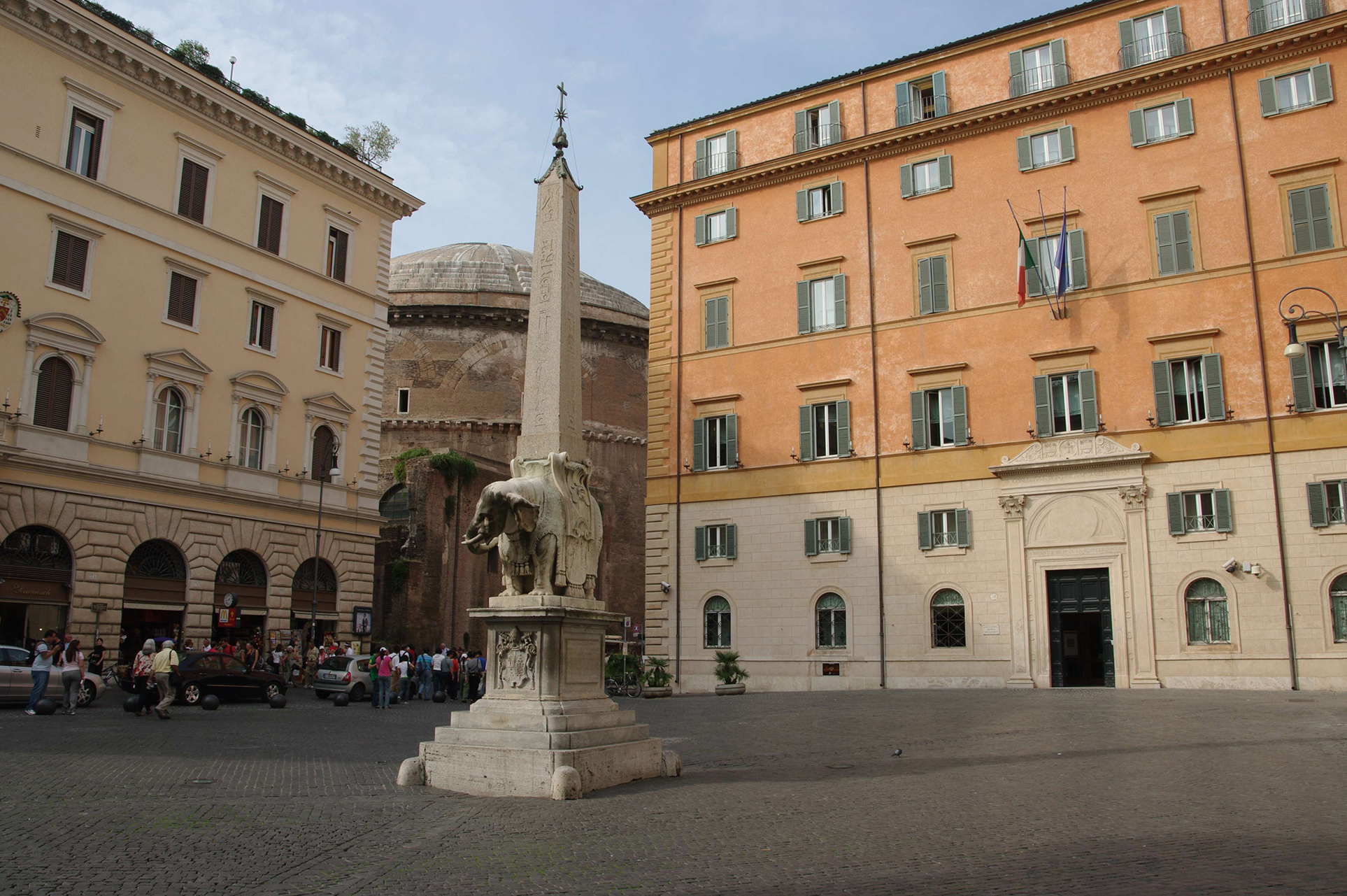
In Piazza della Minerva, directly behind the Pantheon, stands one of the more quietly comic monuments in a city not known for comic monuments. Piazza della Minerva ed il suo Pulcino — the little elephant obelisk that Romans have nicknamed 'il Pulcino,' the chick — was designed by Bernini in 1667. The elephant is small, almost toy-like, with an expression of mild bewilderment. It carries an Egyptian obelisk on its back, which Bernini apparently intended as a meditation on the relationship between strength and wisdom: the elephant bearing ancient knowledge on its spine. Romans, characteristically, decided it looked like a chick and called it that. The square itself is rarely quiet — the Pantheon is a hundred metres away, and the overflow crowds are constant — but the elephant has a way of stopping people mid-stride. Children touch its trunk. Adults photograph it from the wrong angle and then try again. It is, in its modest way, one of the most successful public sculptures in the city.
Il consiglio del team
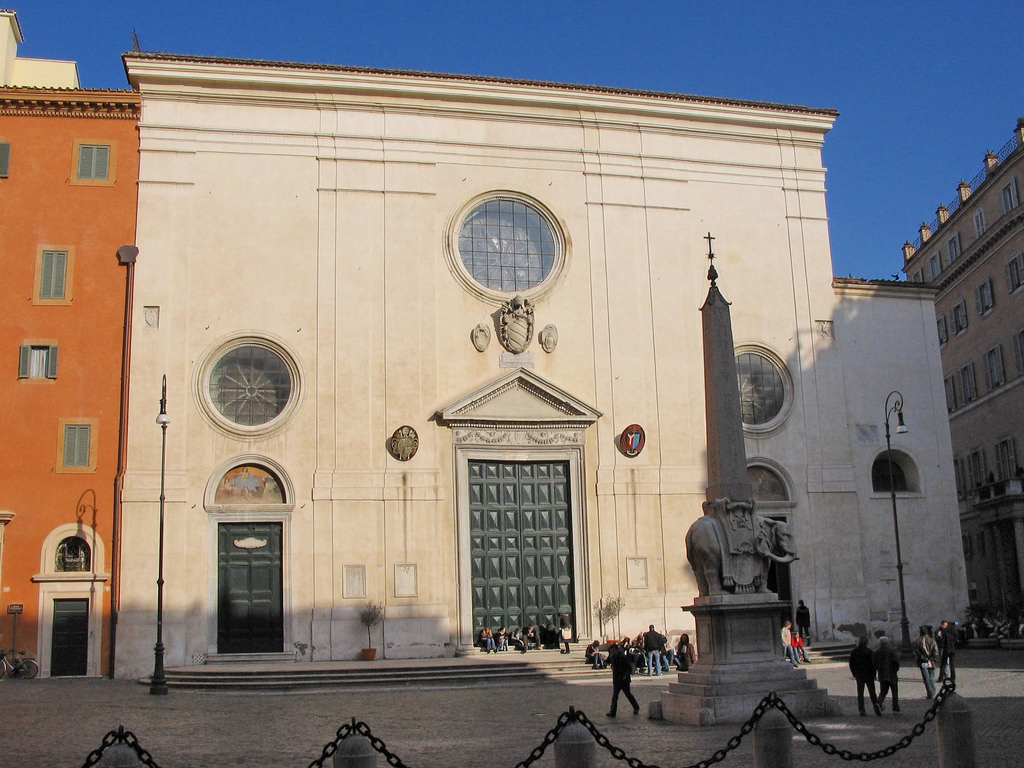
The Dominican church of Santa Maria sopra Minerva is directly behind the elephant. The two are worth visiting in sequence — the contrast between the outdoor whimsy and the interior's severity is instructive.
Santa Maria sopra Minerva is one of the very few Gothic churches in Rome, which in a city of baroque excess makes it feel like a foreign correspondent. Built in the thirteenth century by Dominican friars on the site of an ancient temple to Minerva — hence the name — it has a blue vaulted ceiling painted with gold stars that takes a moment to register as real after the white marble facades of most Roman churches. The relics of Saint Catherine of Siena are kept here, and her tomb draws a steady stream of pilgrims who move through the side aisles with a purposefulness that the casual visitor would do well not to interrupt. Michelangelo's Cristo Portacroce stands near the high altar, a marble figure of Christ carrying the cross that the sculptor apparently found insufficiently finished and wanted to destroy. The church kept it anyway. There is a lesson in that, though I am not sure what it is.
Il consiglio del team
The church closes for a long midday break. Go either in the morning or after four in the afternoon. The light through the rose window is better in the late afternoon in any case.
The Altare della Patria — more properly the Monumento Nazionale a Vittorio Emanuele II, or, as Romans call it with varying degrees of affection, 'la Torta Nuziale' (the wedding cake) or 'la macchina da scrivere' (the typewriter) — is one of those buildings that has been so thoroughly mocked that people forget to look at it. Completed in 1935 after decades of construction, it displaced a significant portion of the medieval Capitoline Hill, which is a fact the Romans have not entirely forgiven. Up close, the white Brescian marble is almost aggressively bright, and the scale — which photographs flatten — is genuinely disorienting. The Tomb of the Unknown Soldier at its base is guarded around the clock, and the changing of the guard, which happens with military precision and no fanfare, is worth watching once. The building is not subtle. It was not designed to be subtle. But it is, on its own terms, a serious piece of architecture, and the view from the top terrace is one of the better ones in Rome.
Il consiglio del team
The elevator to the very top — the Quadriga terrace — costs a few euros and is worth it. Most tourists stop at the lower free terrace and miss the full panorama.
Inside the left wing of the Vittoriano, accessed through a door that most visitors walk past without a second glance, is the Museo Centrale del Risorgimento. Inaugurated in 1970 to mark the centenary of the plebiscite that made Rome the capital of unified Italy, it is a museum that has the atmosphere of a place that has not been disturbed much since its opening. The collection covers the Risorgimento — the nineteenth-century movement for Italian unification — through documents, paintings, weapons, uniforms, and personal effects. It is not a flashy museum. The interpretive panels are dense and assume a degree of prior knowledge that most foreign visitors do not have. But that is also its appeal: it is a museum made for Italians, by Italians, about a subject Italians care about in complicated ways, and the lack of tourist-facing smoothness gives it an honesty that the more curated attractions nearby do not have.
Il consiglio del team
Entry is free, which means there is genuinely no reason not to go in. Allow at least an hour if you want to read the panels rather than just look at the display cases.
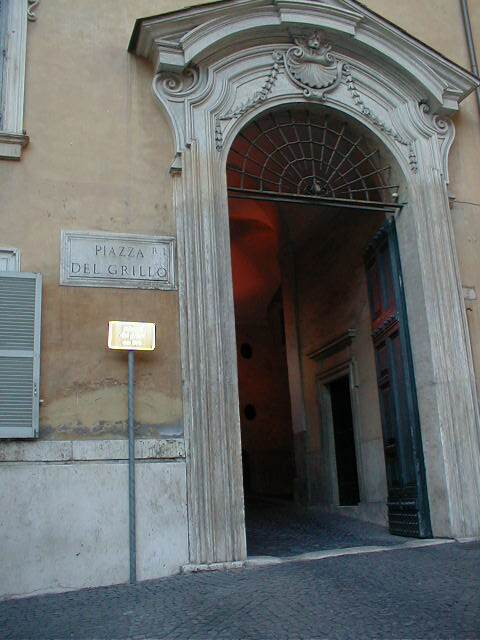
Il Palazzo del Marchese del Grillo sits on a small piazza of the same name, a short walk from the Imperial Forums. The building dates to the seventeenth century — a facade flanked by two projecting wings, the whole thing slightly compressed into its urban setting as if it grew into the space rather than being planned for it. The palazzo is not open to the public in any formal sense, but the piazza in front of it is, and the building's exterior repays the kind of slow looking that Rome rewards. It is best known internationally for Alberto Sordi's 1981 film Il Marchese del Grillo, in which a dissolute Roman nobleman uses his palazzo as the stage for increasingly elaborate pranks on the lower classes. The film is a comedy, but it is also a fairly precise document of a certain Roman relationship to hierarchy and impunity. The piazza tends to be quiet in the mornings, which is rare in this part of the city.
Il consiglio del team
The view from the piazza toward the Imperial Forums and the Torre dei Conti is one of the better unremarked angles in the historic centre. Bring a camera with a wide lens.
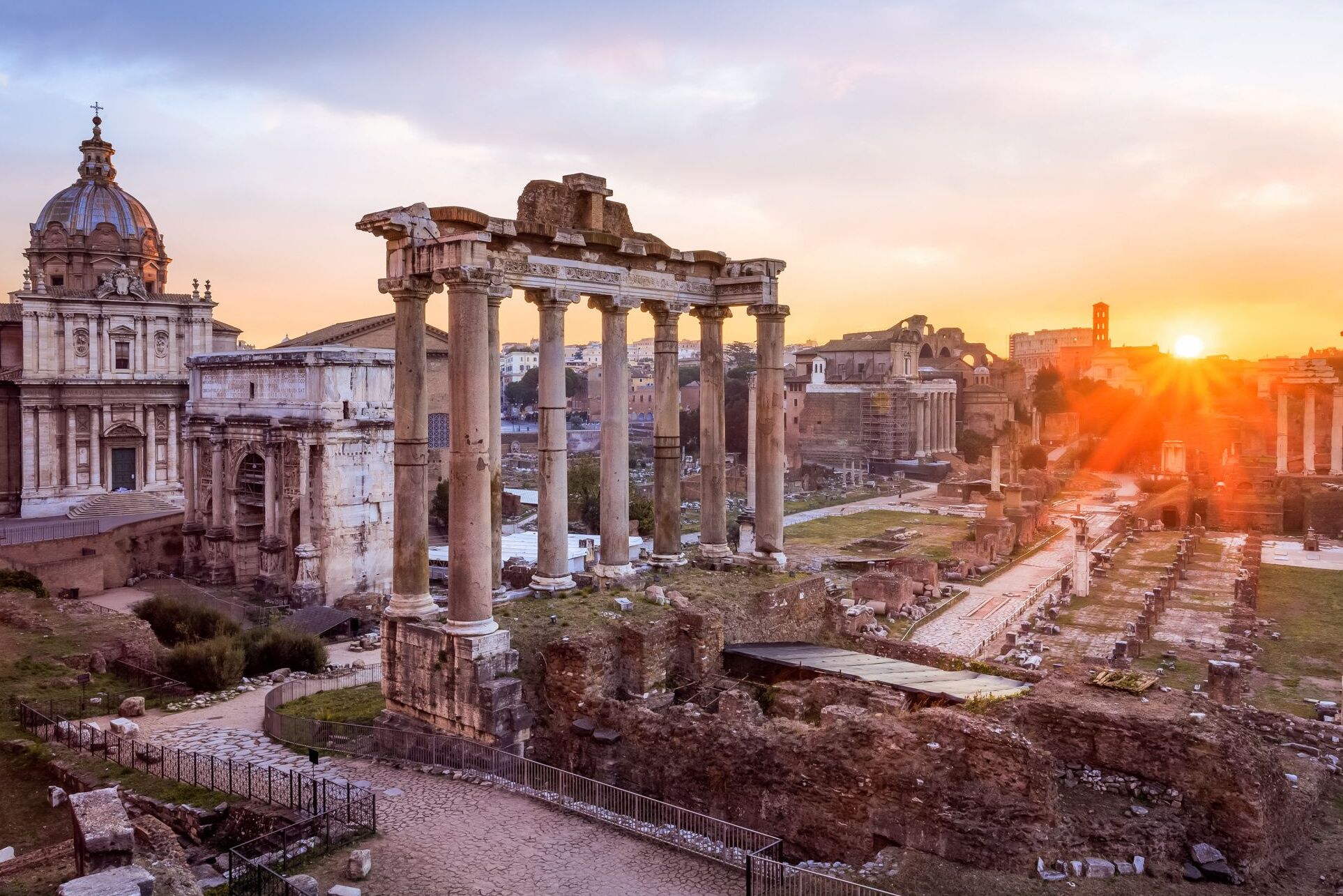
The Roman Forum — Forum Romanum — is on every list, and I have included it here anyway, because the experience of it depends almost entirely on how you approach it, and most people approach it badly. They arrive mid-morning with a tour group, spend forty minutes following a guide who is audible only to the front three rows, and leave feeling they have seen it. They have not seen it. The Forum was the centre of Roman public life for roughly a thousand years: courts, temples, triumphal processions, markets, elections, funerals. What remains is fragmentary — the Arch of Septimius Severus, the Temple of Saturn's eight surviving columns, the Via Sacra worn smooth by two millennia of feet — but the fragments are enough if you give them time. Historians believe the Forum was already being used as a grazing field, the Campo Vaccino, by the medieval period. That arc from world centre to cow pasture to UNESCO site is Rome in miniature.
Il consiglio del team
Buy the combined ticket that includes the Palatine Hill and arrive at the Palatine entrance on Via Sacra rather than the main Forum entrance. The crowds are thinner, and the view down into the Forum from the hill is worth the longer walk.
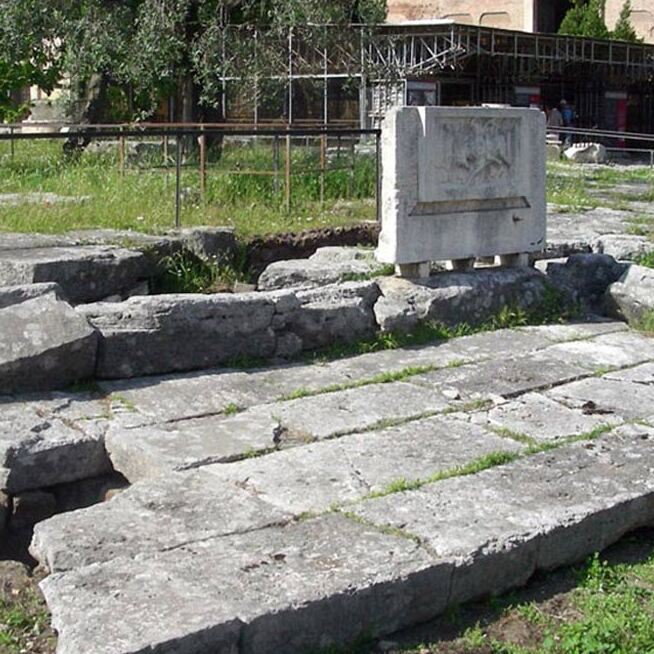
Within the Forum, a few metres from the Curia — the ancient Senate building — there is a small, fenced depression in the ground that most visitors step around without registering. This is the Lacus Curtius, and it has one of the stranger histories of any site in Rome. It is an ancient sacred spot, marked by a small stone well, which the Romans believed was an entrance to the underworld. The legends attached to it are multiple and contradictory: one holds that a chasm opened here and an oracle declared it would only close when Rome threw its most precious possession into it, whereupon a soldier named Marcus Curtius rode his horse into the gap, and the earth closed over him. Whether the lacus was originally a marsh, a lightning strike site, or something else entirely, scholars still debate. What is not debated is that Romans left votive offerings here for centuries. The site is easy to miss, which is part of its character.
Il consiglio del team
There is a worn marble relief near the site depicting a horseman — thought to represent Curtius himself. It is small and at ground level. Most people photograph the Arch of Septimius Severus behind them and never look down.
La terrazza del Campidoglio offers three separate panoramic terraces from the Capitoline Hill, and two of them are free, which in Rome in 2024 is a minor civic virtue. The hill itself — the Capitolium, the religious and political centre of ancient Rome — was redesigned by Michelangelo in the sixteenth century, and the piazza he created, with its oval pavement pattern and the bronze equestrian statue of Marcus Aurelius at its centre (a copy; the original is inside the Capitoline Museums), remains one of the more considered urban spaces in the city. The terraces behind the Palazzo Senatorio look out over the Forum, and the view is the kind that makes you understand, briefly and without sentimentality, why people have been writing about this city for two thousand years. The terrace to the front looks toward the Vittoriano and the city's roofline. Both are worth your time, at different hours.
Il consiglio del team
The terrace behind the Palazzo Senatorio is best at dusk, when the Forum stones take on a colour that is difficult to describe and impossible to photograph accurately. Go twice if you can: once in the morning for the light, once in the evening for the mood.
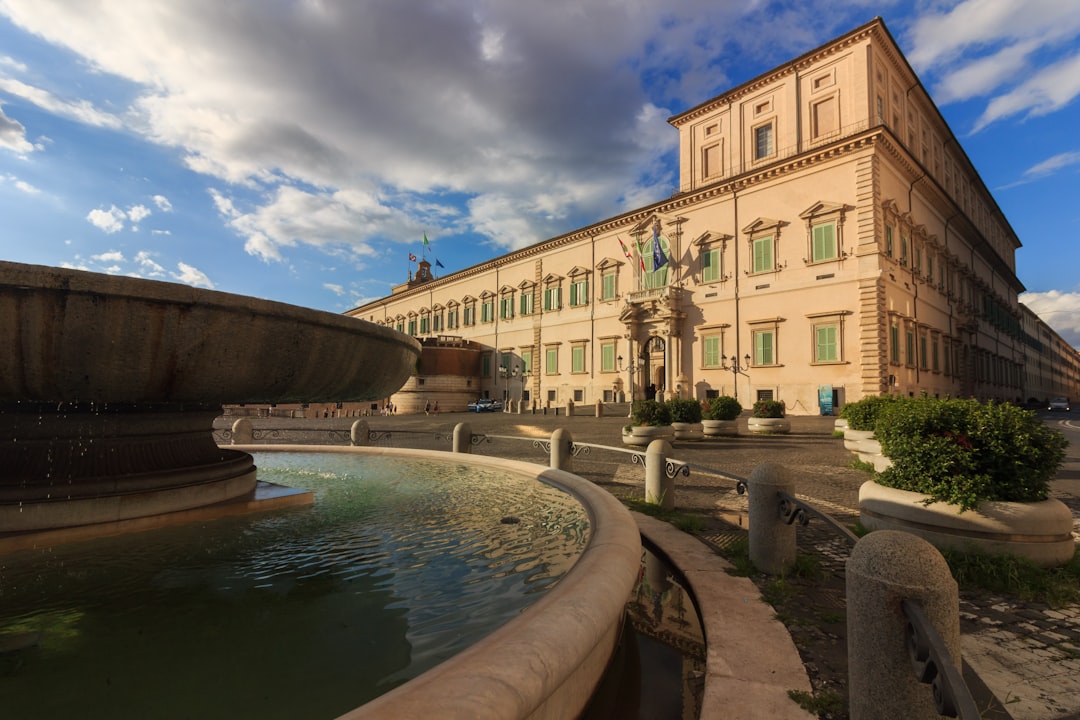
The Palazzo del Quirinale sits on the highest of Rome's seven hills and has served as the official residence of the President of the Italian Republic since 1948, before which it was home to popes and, briefly, to Italian kings. The building is not small — it has been expanded and modified over four centuries, and the complex includes gardens that cover several hectares. What most visitors do not know is that the palazzo opens to the public on certain days, including Sunday mornings during specific periods, and that the interior — frescoes, tapestries, state rooms of considerable scale — is accessible without the kind of queuing that the Vatican demands. The gardens are a particular draw: formal in their structure but with a lived-in quality that the more famous Villa Borghese gardens, further north, do not always achieve. The Quirinal Hill also offers views across Rome that are less photographed than the Janiculum or the Pincio.
Il consiglio del team
Check the official Quirinale website for opening dates and book in advance — entry is free but ticketed, and availability goes quickly. The Sunday morning openings in autumn tend to be the least crowded.
There is a version of Rome that exists entirely for visitors, and it is not without its pleasures. The gelato is frequently good. The light in October is the colour of old varnish. The fountains run cold water in summer and nobody has yet thought to charge for it. But the city that stays with you — the one you find yourself describing to people who haven't been, with a specificity that surprises even you — is the one built from smaller encounters. A pine cone fountain that nobody photographs. A Gothic nave in a city of Baroque ceilings. A stone well in a field of ruins where Romans once believed the earth had opened to receive a man on horseback.
Rome is not a city that can be done. This is its central fact and its central frustration. Every visit ends with a list of things you didn't get to, a neighbourhood you walked through too quickly, a church that was closed for restoration. The city is always partly inaccessible, always partly under scaffolding, always partly in the process of becoming something slightly different from what it was last time. This is not a flaw. It is the condition that makes return visits feel less like repetition and more like continuing a conversation that you began, without quite realising it, the first time you stood in front of something very old and felt the particular vertigo of understanding, briefly, how short your own time is.
★ Guida tascabile
Porta questa guida con te.
Salvala offline, ottieni le indicazioni a piedi e scopri migliaia di luoghi come questi.
April, May, and October offer the most manageable combination of weather and crowd levels. August is when Romans leave and tourists arrive in their place — the city is hot, some neighbourhood restaurants close for the month, and the major sites are at peak congestion. November and February are cold and occasionally rainy but the Forum and Palatine Hill are nearly empty, which has its own appeal. Avoid the week between Christmas and New Year if you dislike crowds; the city is beautiful but extremely busy.
Do I need to book tickets in advance for the main sites?
For the Colosseum and Roman Forum combined ticket, advance booking is effectively mandatory in spring and summer — the same-day queue is long and the timed-entry slots sell out. The Capitoline Museums can usually be booked a day or two ahead. The Palazzo del Quirinale requires advance booking through its official website. The Vatican Museums should be booked weeks in advance between March and October. Santa Maria sopra Minerva, the Vittoriano terraces, and the Campidoglio terraces require no booking.
Is Rome walkable, or do I need public transport?
The historic centre is compact enough that most of the destinations in this article are within a kilometre of each other and easily walkable. The terrain is flatter than the city's reputation for seven hills suggests, at least in the central area. The metro is useful for reaching Trastevere, the Vatican, and the Borghese Gallery, but the two main lines do not cover the historic centre well. Buses are reliable but slow in traffic. Walking is almost always the better choice within the centre, and the street-level detail rewards it.
Are there common tourist scams I should know about?
Yes. Around the Colosseum and Trevi Fountain, men in centurion costumes will pose for photographs and then demand payment — sometimes aggressively. Near the major piazzas, unofficial 'guides' will attach themselves to you and expect a fee. Restaurants immediately adjacent to tourist sites frequently charge significantly more than those two streets away, and some add cover charges that are not clearly disclosed. The simplest rule: if someone approaches you in a tourist area offering something unsolicited, the transaction will not be in your favour.
What should I know about dress codes for churches?
Shoulders and knees must be covered to enter any Roman church, including Santa Maria sopra Minerva. This is enforced with varying degrees of consistency — some churches turn people away, others sell paper shawls at the door, others have given up entirely. The safest approach is to carry a light scarf or a layer that covers your shoulders, which doubles as useful clothing in the variable temperatures of spring and autumn. The Vatican enforces its dress code more strictly than most individual churches.
★ Leggila quando vuoi
Salvala sul tuo telefono.
Aggiungi questa guida ai preferiti, pianifica il viaggio offline, scopri luoghi come questi.