10 Best Things to Do in Prague, Czech Republic — beyond the obvious
A long-term resident's guide to the city's real texture, including the parts that resist easy enthusiasm
L
Una guida di
Lena Hofmann
Aggiornata il
21 ottobre 2026
Lettura
13 minuti
Comprende
7 luoghi · mappa interattiva
★ Guida d'Italia 2026
Pianifica con cura. Viaggia più a fondo.
1.3M+ luoghi curati nel mondo, mappe offline e itinerari intelligenti — tutto in un'app gratuita.
1.3M+ luoghiMappe offlineItinerari AIGratis
I arrived in Prague for what was supposed to be three weeks and stayed, on and off, for the better part of four years. This is not a boast. It is partly an admission that I kept failing to leave, and partly an explanation of why I feel entitled to say what I am about to say: the version of Prague that most visitors experience — the Charles Bridge at sunrise, the astronomical clock on the hour, Staroměstské náměstí in December — is not wrong, exactly, but it is thin. It is the city as postcard, as backdrop, as the set of a film in which the tourist is always the protagonist.
Prague is one of the few European capitals that survived the twentieth century's appetite for demolition more or less intact. The medieval street plan of Staré Město, the baroque excess of Malá Strana, the art nouveau facades of Vinohrady — these are not reconstructions. They are the thing itself, which makes the city simultaneously remarkable and slightly exhausting to think about. Fourteen centuries of continuous habitation compressed into fewer than five hundred square kilometres, and most visitors spend two days in a radius of about eight hundred metres.
What follows is not a list of secrets. I am suspicious of that word, which travel writing uses to mean 'things I know and you don't,' as if knowledge were a competitive sport. These are, rather, ten ways of being in Prague that require a little more patience, a little more willingness to be confused, and a little less deference to the laminated menus of the Old Town. Some of them will disappoint you. That, I have come to believe, is the point.
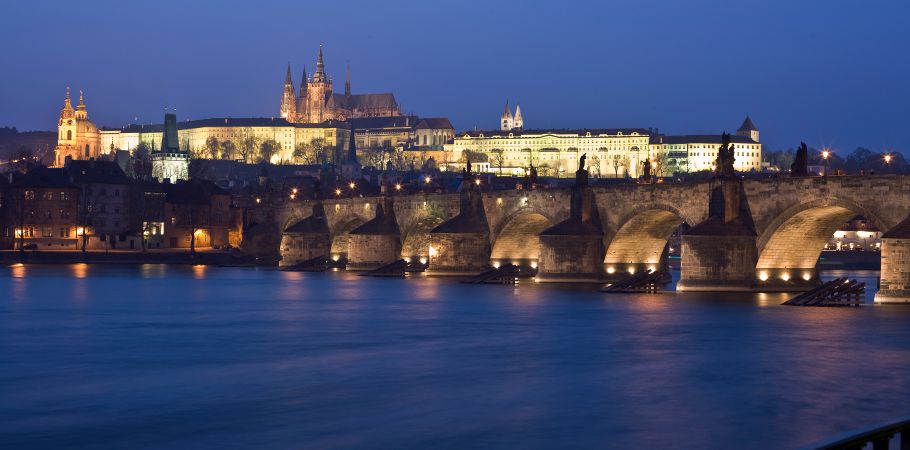
The Ponte Carlo (Karluv Most) is a fourteenth-century stone bridge in the Gothic manner, connecting Staré Město to Malá Strana across the Vltava. Charles IV commissioned it after the previous Judith Bridge was swept away by a flood in 1342, and it remained Prague's only river crossing for several centuries — which explains why it still feels, even now, like the city's spine. What nobody tells you is that the bridge is best understood not at the golden hour that every photographer recommends, but in the middle of a grey Tuesday afternoon in November, when the tourist density drops enough that you can actually stop at one of the thirty Baroque statues and read the plaque without someone's selfie stick grazing your ear. The statues are mostly seventeenth- and eighteenth-century additions, some of them copies — the originals are in Lapidárium — and they have the slightly worn dignity of things that have been rained on for three hundred years. That weathering is the point. The bridge is not a monument to triumph; it is a monument to persistence.
Il consiglio del team
Cross it westward in the early morning if you want the light on the castle, but cross it eastward after 9 p.m. if you want to understand what the city sounds like when it is mostly just itself — a few musicians, some pigeons, the river.
The Jewish Quarter, Josefov, is one of the most freighted places in Central Europe, and it is also one of the most visited, which creates an uncomfortable friction that is worth sitting with rather than resolving quickly. The Old Jewish Cemetery, where bodies were buried in layers because the community had so little land, is genuinely difficult to look at without feeling the weight of what it represents. Most visitors spend forty minutes there and then go for lunch. The better approach — the one that a Weekend Praga itinerary rarely suggests — is to spend a full morning in the quarter and then walk north into Holešovice, where the Veletržní palác houses the National Gallery's modern and contemporary collection in a functionalist trade-fair building from 1928. The contrast between medieval compression and twentieth-century spatial ambition is one of Prague's more instructive juxtapositions, and Holešovice itself is a neighbourhood that still has the slightly unfinished quality of a place that knows it is becoming something but has not decided what yet.
Il consiglio del team
The combined ticket for the Jewish Museum sites is not cheap, but it is the only way to see the Pinkas Synagogue, whose walls are inscribed with the names of 77,297 Bohemian and Moravian Jewish victims of the Holocaust. That room deserves more than the time most visitors give it.
Czech beer is genuinely excellent and the mythology around it is not entirely manufactured. But the wine culture that has been developing in Prague over the past decade — particularly around Moravian and Bohemian natural producers — is less discussed and, for a certain kind of traveller, more interesting. The small wine bars that have appeared in Žižkov, Vinohrady, and along the edges of Holešovice tend to operate on the principle that the person behind the bar knows something you don't and is willing to tell you, which is a different experience from the managed hospitality of the Old Town. The best of them have no menus in English, which is a mild friction that usually resolves itself within two minutes and occasionally produces a conversation worth having. Using planning tools — whether a paper map, a local recommendation, or one of the newer AI-assisted travel platforms like those discussed under the Migliori app viaggio 2026 category — can help you locate these places before you arrive, though the tool is only as good as the question you ask it.
Il consiglio del team
Žižkov has the highest density of pubs per capita of any district in Europe, or so the locals claim. The number may be apocryphal, but the density is real. Walk up Seifertova and turn left at random.
The Farmers' Market at Náměstí Míru in Vinohrady runs on Saturdays and has, over the years, become the kind of place where you can have a reasonable conversation about the provenance of a piece of cheese. This is not a small thing in a city where the tourist-facing food economy is largely organised around the principle of volume. The market is about four kilometres from the Old Town, which means it is not on most two-day itineraries, which means it is mostly full of people who live nearby. AI Trip Planner 2026 tools, which have become genuinely useful for mapping neighbourhood-level logistics rather than just landmark-to-landmark routing, are reasonably good at surfacing this kind of local fixture if you ask the right question — something like 'where do people in Vinohrady buy food on a Saturday morning' rather than 'best food markets in Prague.' The distinction matters. The first question gets you a market; the second gets you a list.
Il consiglio del team
The trdelník you will be offered everywhere in the Old Town is not a traditional Czech pastry in any meaningful historical sense. The Náměstí Míru market sells chlebíčky, open-faced sandwiches that are actually traditional, and they are better.
The equestrian statue of Jan Žižka on Vítkov Hill is, by some accounts, the largest bronze equestrian statue in the world. It sits above a mausoleum that served, in sequence, as a monument to Czechoslovak statehood, a Communist pantheon, and then, after 1989, a kind of embarrassed silence. The National Monument at Vítkov is now a museum, and the hill itself offers a view over Žižkov and the eastern city that is less composed than the view from Petřín — fewer spires arranged for the camera — but more honest about what Prague actually is: a city of several centuries layered on top of each other, with the functionalist and the medieval and the Communist-era panel buildings all visible at once. The walk up from Žižkov takes about fifteen minutes and involves no ticket queue. Viaggio Praga Consigli guides that go beyond the standard itinerary tend to mention Vítkov; the ones that don't are telling you something about their priorities.
Il consiglio del team
The monument's interior is worth the small entry fee for the scale of its ambition alone — it was designed in the 1920s and completed in the 1930s, and it has the slightly tragic grandeur of a project that outlived the ideology it was built to celebrate.
Vyšehrad is the older of Prague's two great fortified heights — older, at least, in legend, though the current fortifications date from the seventeenth century — and it sits about two kilometres south of the Old Town on a bluff above the Vltava. The Romanesque rotunda of St. Martin, the cemetery where Dvořák and Smetana are buried, the remains of the Romanesque basilica: these are all here, and the site receives a fraction of the visitors that the Castle does. The comparison between planning tools like Secret World vs TripIt is, in this context, a useful metaphor for a broader question about how we navigate cities: do you want an app that tells you what to do, or one that gives you enough information to make your own decisions and then leaves you alone? Vyšehrad rewards the second approach. It is a place where you can sit on the ramparts for an hour and watch the river and not feel that you are doing something wrong by not moving.
Il consiglio del team
The cemetery is not morbid in the way you might expect. It is, rather, a beautifully maintained Slavin pantheon where the graves of composers, writers, and painters are arranged with a formality that feels more like a library than a graveyard.
The Museum of Communism is on Na Příkopě, which is Prague's most aggressively commercial street, above a McDonald's and next to a casino — an arrangement that is either deeply ironic or simply Czech. The museum itself is uneven: some rooms are genuinely illuminating about daily life under the Czechoslovak Communist regime, others feel like they were assembled in a hurry by someone who had read about the period but not lived it. What redeems it is the testimony. The recorded voices of people describing what it was like to be interrogated by the StB, to apply for a passport and be refused, to lose a job because of a relative's political associations — these are not abstractions. Prague is a city where the twentieth century is still close enough to touch, and the AI Trip Planner 2026 tools that help you sequence your days can put this museum in the morning and the beer garden in the afternoon, but they cannot tell you how long you will need to stand in the interrogation room reconstruction before you are ready to leave.
Il consiglio del team
The gift shop sells genuinely good reproductions of Communist-era propaganda posters. They are not kitsch in the way you might expect — they are, in fact, quite beautiful as graphic design, which is part of what made them effective.
Prague is a city that has been described so many times, in so many languages, that the descriptions have begun to accumulate like sediment over the actual place. Kafka, the Golden Lane, the astronomical clock, the beer: these are not false, but they are worn smooth by repetition, and a worn-smooth thing loses its edges, which is where the interest usually lives.
What I keep coming back to, after all the time I spent there, is the city's particular relationship with its own past — not nostalgic exactly, not proud exactly, but something more complicated, closer to the expression of a person who has survived something they are not entirely sure how to talk about. The twentieth century was not kind to Prague, and the city carries that in ways that are not always visible to someone who arrives for a long weekend and leaves having seen the castle and the bridge and the Jewish Quarter.
The ten things in this list are not the ten best things in Prague. They are ten ways of paying attention to a city that rewards attention more than it rewards enthusiasm. The distinction matters. Enthusiasm is easy and brief; attention is slower and leaves something behind. Prague has been here for fourteen centuries. It will wait.
★ Guida tascabile
Porta questa guida con te.
Salvala offline, ottieni le indicazioni a piedi e scopri migliaia di luoghi come questi.
The honest answer is that there is no perfect time, only trade-offs. May and September offer reasonable weather and slightly lower crowds than July and August, when the Old Town becomes genuinely difficult to move through. November and February are cold and grey and the city is at its least performative, which some people find more interesting than the peak-season version. December has the Christmas markets, which are atmospheric but crowded, and the prices around them are higher than at any other time of year.
How many days do you actually need in Prague?
Three days is enough to see the canonical sites without feeling rushed. Four or five days is enough to start exploring the neighbourhoods — Žižkov, Vinohrady, Holešovice, Smíchov — that give the city its actual character. A week allows you to develop something like a routine, which is when you start to understand a place rather than just observe it. Two days, which is what many visitors allocate, is enough to feel that you have been there, which is different from enough to understand why people stay.
Is Prague expensive compared to other European capitals?
It is cheaper than Paris, London, or Amsterdam, but the gap has narrowed considerably over the past decade, particularly in the Old Town and Malá Strana. A meal in a tourist-facing restaurant in Staré Město can cost as much as a comparable meal in Vienna. The further you move from the centre — both geographically and in terms of the type of establishment — the more the price differential reasserts itself. Beer remains relatively affordable by Western European standards.
What are the most common tourist scams in Prague and how do you avoid them?
Currency exchange offices in the Old Town frequently advertise misleading rates and charge commissions that are not disclosed until after the transaction. Use an ATM attached to a major bank and decline the machine's offer to convert the currency for you — accept the charge in Czech crowns and let your own bank handle the conversion. Unlicensed taxis near the Old Town Square have a long history of overcharging; use the Bolt or Liftago apps instead. Some restaurants in the tourist centre add items to bills that were not ordered; check itemised receipts.
How useful are AI travel planning tools for a city like Prague?
They are useful for what they are good at: logistics, opening hours, neighbourhood sequencing, transport connections. Prague's public transport system — trams, metro, and buses — is well-documented and AI planning tools handle it reasonably well. Where they are less useful is in capturing the texture of a city that rewards improvisation: the bar you find because you turned the wrong way, the courtyard you enter because the gate was open. Use the tools to build a framework and then be willing to discard it. The framework is not the trip.
★ Leggila quando vuoi
Salvala sul tuo telefono.
Aggiungi questa guida ai preferiti, pianifica il viaggio offline, scopri luoghi come questi.