10 Best Day Trips from Marrakech — by train, car, and boat
A working guide to getting out of the medina and back before midnight
L
Una guida di
Lena Hofmann
Aggiornata il
17 giugno 2026
Lettura
13 minuti
Comprende
9 luoghi · mappa interattiva
★ Guida d'Italia 2026
Pianifica con cura. Viaggia più a fondo.
1.3M+ luoghi curati nel mondo, mappe offline e itinerari intelligenti — tutto in un'app gratuita.
1.3M+ luoghiMappe offlineItinerari AIGratis
Marrakech has a way of eating your time. The souks pull you in one direction, the Djemaa el-Fna pulls you in another, and before you know it three days have passed and you haven't left the city walls. That's not entirely a bad thing — the city rewards deep attention — but at some point the sensory density becomes its own kind of noise. That's when a day trip stops being a tourist option and starts being a necessity.
A good day trip from Marrakech does one specific thing: it changes the register. Not just the scenery, but the pace, the air quality, the social temperature. The Atlas Mountains are fifty kilometers away and feel like another planet. The road south to Aït-Ben-Haddou crosses a geological argument between red rock and blue sky. The waterfalls at Ouzoud make the heat of the Haouz plain feel like a rumor.
I've done all of these trips multiple times, in rental cars, shared taxis, private transfers, and on foot. I've made the mistake of arriving at the wrong hour and the smarter choice of leaving at dawn. What follows is not a list of places that look good in photographs — it's a list of places that justify the logistical effort of getting there and back in a single day, with enough time left over to actually feel something before you climb back into the car.
Marrakech's position at the edge of the High Atlas is the key geographic fact that makes all of this possible. Most of these destinations sit within a two-hour drive. None of them require an overnight. All of them will make the city feel different when you return to it — smaller, somehow, and more comprehensible.
The village of Imlil sits at roughly 1,740 meters, about 90 minutes by car from Marrakech via the S501 road through Asni. You don't need a four-wheel drive for this route in dry conditions, but the road narrows significantly after Asni and the final kilometers demand patience. The Kasbah du Toubkal itself is the dominant structure above the village — a converted caïd's residence turned into what is genuinely the most considered base in the High Atlas. Even if you're not staying, you can arrange day access for lunch on the terrace, which gives you one of the better panoramic views in the region without committing to a summit attempt.
On arrival, walk the mule trails above the village toward the Aremd hamlet, hire a local Berber guide for a two-hour circuit through walnut groves, or simply sit on the kasbah's roof terrace and watch the Toubkal massif change color through the afternoon. The drive back to Marrakech in low evening light through the Moulay Brahim gorge is worth the trip on its own.
Il consiglio del team
Leave Marrakech no later than 7:30am. The road through Asni gets congested with local market traffic on Saturdays. Book lunch at the kasbah at least 48 hours in advance — they manage capacity carefully and walk-ins are frequently turned away.
The approach to Toubkal's summit is a two-day proposition for most people, but the lower reaches of the route — from Imlil up through the Mizane valley toward the Toubkal refuge at 3,207 meters — make for one of the most rewarding half-day walks in North Africa, even if you turn back well before the top. The trail has been used as a film location precisely because the landscape is so cinematically extreme: red scree, bare ridgelines, the occasional Berber shepherd moving through terrain that looks uninhabited but isn't.
For a day trip, the realistic goal is the refuge, not the summit. That's still a serious walk — around 1,500 meters of vertical gain — and requires a reasonable fitness level and proper footwear. The reward is the silence above the treeline and the specific quality of light that hits the south-facing slopes in the early afternoon. Come down by 3pm to make Marrakech before dark.
Il consiglio del team
Toubkal National Park charges a small entrance fee payable at the park gate above Imlil. Bring cash — there are no card facilities. Accredited mountain guides can be hired in Imlil village; don't attempt the upper trails alone if you don't know the terrain.
Morocco's Atlas system is not one thing but three — the Anti-Atlas, the Middle Atlas, and the High Atlas — and the day-trip geography from Marrakech gives you access primarily to the High Atlas, with the Anti-Atlas beginning to appear as you push south toward Ouarzazate. For visitors who want to understand the mountain system as a whole rather than fixate on a single peak, the drive along the N9 from Marrakech through the Tizi n'Tichka pass (2,260 meters) is the most instructive single road in Morocco. The pass itself is driveable in a standard rental car outside of winter, and the views from the summit reveal the dramatic shift from the Haouz plain on the northern side to the pre-Saharan landscapes on the south.
Stop at the pass for tea, walk the ridge above the road for twenty minutes, and absorb the scale of what you're looking at. Three parallel ranges, all of them running roughly southwest to northeast, all of them older than the Alps.
Il consiglio del team
The Tizi n'Tichka pass can close without warning in winter due to snow. Check road conditions with your hotel the evening before. The pass is typically clear from April through October, but altitude weather is unpredictable in shoulder seasons.
At 4,167 meters, Toubkal is the highest point in North Africa, and the Berber trails that approach it carry centuries of use — these are not recreational paths invented for tourism but working routes between villages that happen to pass through spectacular terrain. The section of trail above Imlil known locally as the sentieri berberi (Berber paths) winds through terraced fields, past irrigation channels called seguias, and through villages where the architecture is entirely functional: thick-walled earthen houses designed to hold heat against the cold nights and shade against the summer sun.
For a day trip focused on cultural texture rather than altitude, spend your time on these lower trails rather than pushing for the high plateau. The interaction between the agricultural terracing and the raw mountain above it is the visual argument this landscape makes most convincingly. Hire a guide in Imlil who speaks the local Tachelhit dialect — the conversations you'll have are worth more than any summit selfie.
Il consiglio del team
Tachelhit-speaking guides who know the village networks charge roughly the same as certified mountain guides but offer a fundamentally different kind of trip. Ask at the Imlil guide bureau specifically for a village-circuit itinerary rather than a summit route.
There is a version of the Toubkal day trip that is less about physical challenge and more about proximity to something genuinely large. The mountain's presence — its mass, its silence, the way it reorganizes the sky above Imlil — is available to anyone who makes the drive, not just those who summit it. The lower approach through the Mizane valley offers this sense of scale within the first hour of walking, and the combination of Berber village life in the foreground with the Toubkal massif behind it is the kind of visual contrast that stays with you.
For families or less mobile travelers, the village of Imlil itself rewards a slow morning: the cooperative shops, the mule handlers preparing loads for higher camps, the school children moving through lanes that have been worn smooth by generations of foot traffic. This is the mountain as inhabited place, not just as adventure destination.
Il consiglio del team
Parking in Imlil is straightforward but the lot fills by 9am in high season (July–August). Arrive early or arrange a driver who can wait outside the village. The walk from the parking area to the village center takes about ten minutes on a well-marked path.
The ksar of Aït-Ben-Haddou sits about 103 kilometers from Marrakech via the N9 over the Tizi n'Tichka pass — call it two hours in good conditions, longer if you stop at the pass. The site is a UNESCO World Heritage ksar: a fortified earthen city built from clay bricks in a style that evolved over centuries as a defensive response to the specific conditions of the pre-Saharan south. It has been used as a film location so many times that some visitors arrive expecting a theme park and find instead a living village — a small number of families still occupy the upper sections of the ksar.
Cross the river on foot (there are stepping stones in low water; a donkey cart in high season), climb to the granary at the top for the view over the Ounila valley, and walk the outer walls in the late afternoon when the light turns the pisé architecture from brown to something closer to copper. The new village on the opposite bank has restaurants and craft shops — eat lunch there before the return drive.
Il consiglio del team
Tour buses from Marrakech arrive between 10am and 2pm. If you cross the river before 9am or after 3pm, you'll have the upper ksar almost to yourself. The drive back over the Tichka pass in the dark is not recommended — plan your departure from Aït-Ben-Haddou no later than 4pm.
The same coordinates as the ksar, but a different angle on it. Ait-Ben-Haddou as a village — rather than as a film location or a UNESCO site — is a place where the construction logic of southern Moroccan earthen architecture is most legible. The clay bricks are made from local soil mixed with straw and dried in the sun; the towers are load-bearing and decorative simultaneously; the narrow lanes between buildings create shade corridors that function as natural air conditioning. Walking through the inhabited sections with a local guide who can explain the construction and social organization of a ksar turns what might be a photographic exercise into something more genuinely educational.
The village is about 32 kilometers from Ouarzazate, which makes a combined day trip — Tichka pass, Ait-Ben-Haddou, Ouarzazate, return — logistically tight but achievable if you leave Marrakech by 6:30am.
Il consiglio del team
The earthen buildings require constant maintenance and sections are occasionally closed for restoration. The outer path around the base of the ksar is always accessible even when inner lanes are under repair — it gives a useful structural overview of the whole complex.
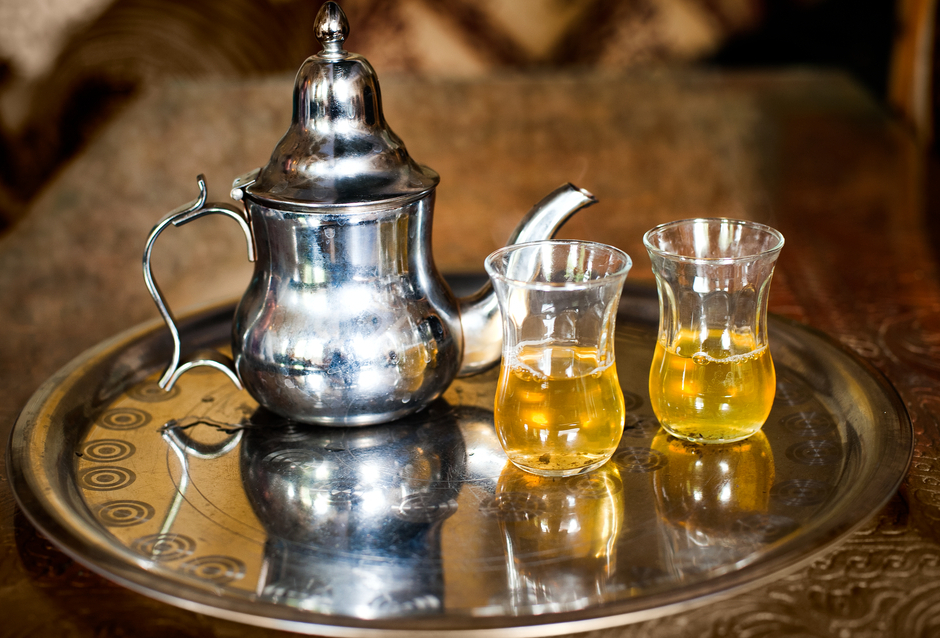
This is not a destination in the conventional sense but a practice that transforms every stop on any of these day trips. Moroccan mint tea — green tea steeped with spearmint and sweetened heavily, poured from height to create the characteristic froth — is the social lubricant of the Atlas and the pre-Saharan south. At roughly 86 kilometers from Marrakech in the direction of the Haouz plain, the tea culture shifts perceptibly: it becomes slower, more ceremonial, more insistent. Refusing tea in a Berber household or a roadside café is not rude, but accepting it and sitting with it for the twenty minutes it deserves opens doors that rushing past them never would.
Build a tea stop into every itinerary on this list. In Imlil after a morning walk. In the new village at Ait-Ben-Haddou before the drive home. At the rim above Ouzoud. The tea itself is always the same; the conversation around it is always different.
Il consiglio del team
The ritual of pouring from height (sometimes called 'the pour') aerates the tea and creates the froth that indicates a properly made glass. If your tea arrives without froth in a place where you'd expect ceremony, it's been rushed. This is useful information about the establishment.
The Imouzzer Cascades — formally the Imouzzer Ida Ou Tanane waterfall — sit about 178 kilometers from Marrakech in the Souss-Massa-Drâa region, making this the longest drive on this list and the one that requires the most disciplined early start. The waterfall itself is remarkable in structural terms: over 100 meters tall with an enormous fan-shaped tufa formation beneath it, created over centuries by calcium-rich water depositing mineral layers as it falls. For most of the year the flow is modest, but the tufa formation is impressive regardless of season — it looks like a frozen geological event.
The road from Agadir (the more logical approach from this direction) winds through argan tree country, and the landscape en route is part of the value. The Souss valley below Imouzzer is one of the most productive agricultural zones in Morocco — citrus, argan, market gardens — and the shift from Marrakech's dusty plain to this greener, more humid microclimate is pronounced. Combine with a morning in Agadir if you want to break the drive.
Il consiglio del team
This is the one destination on this list that works better as an overnight than a strict day trip from Marrakech — the drive is simply too long to do both ways in a single day without exhausting yourself. If you insist on a day trip, leave Marrakech by 5:30am and take the A7 motorway south to Agadir before heading north to Imouzzer.
Every city has a radius of escape, and Marrakech's is unusually rich. Within two hours in almost any direction, the landscape changes so completely that the city feels like it belongs to a different country — which, in a sense, it does. The Marrakech of the souks and the Marrakech of the Toubkal massif are not in easy conversation with each other, and that gap is precisely what makes the day trip valuable.
What I've learned from doing these routes repeatedly is that the return matters as much as the arrival. Coming back into the medina after a day in the Atlas — dusty, slightly tired, with the smell of mountain air still in your jacket — resets your relationship with the city. The noise of the Djemaa el-Fna sounds different after a morning of genuine silence. The density of the souks feels less overwhelming after the openness of the Ounila valley.
Take the trips. Come back before dark. The city will be waiting.
★ Guida tascabile
Porta questa guida con te.
Salvala offline, ottieni le indicazioni a piedi e scopri migliaia di luoghi come questi.
What is the best time of year for day trips from Marrakech?
April through June and September through October are the most reliable months. Spring brings the best conditions for the Atlas — trails are clear, snowmelt swells the waterfalls at Ouzoud and Imouzzer, and the temperatures at altitude are manageable. July and August are hot on the plains but actually workable in the mountains; the Tichka pass road is clear and Ait-Ben-Haddou is at its most visually dramatic in the dry summer light. Avoid the Atlas high routes in December through February unless you have winter hiking experience — snow can close the Tichka pass and make the Toubkal approach genuinely dangerous.
Is there a train from Marrakech to any of these destinations?
Honestly, no — not to any destination on this specific list. ONCF (Morocco's national rail) connects Marrakech to Casablanca, Rabat, Fes, and the north, but the Atlas Mountains, Ait-Ben-Haddou, and Ouzoud are not on the rail network. For all destinations listed here, your options are: rental car (most flexible), shared grand taxi from Bab Doukkala or Bab er-Rob (cheapest but requires patience with departure times), or a private driver hired through your riad (most expensive but removes all logistical stress). For Ouzoud specifically, there are organized day-trip minibuses from Marrakech that depart from Jemaa el-Fna — these are a reasonable option if you don't want to drive.
Do I need a four-wheel drive to reach Imlil and the Atlas villages?
Not for the main road to Imlil in dry conditions. The S501 from Asni to Imlil is paved but narrow, with some steep sections and sharp bends. A standard rental car handles it fine between April and October. What you do need is a car with reasonable ground clearance — very low sports cars or large sedans will scrape on the final approach. In winter or after heavy rain, a 4WD is strongly advisable. For destinations beyond Imlil (higher villages, trailheads above the main path), a 4WD or mule is the only realistic option. Your rental company in Marrakech will advise on current road conditions.
How do I hire a reliable local guide for the Atlas Mountains?
The Bureau des Guides in Imlil village is the official starting point — guides registered there are licensed by the Moroccan Ministry of Tourism and have completed formal mountain training. Prices are regulated and posted at the bureau. For village-circuit walks focused on Berber culture rather than summit routes, ask specifically for a guide with experience in the lower valley circuits rather than the Toubkal summit route — these are different skill sets. Avoid accepting guide offers from individuals who approach you in Marrakech's medina claiming to arrange Atlas guides — the markup is significant and the quality is inconsistent. Book directly in Imlil or through your riad's concierge using a named contact.
What should I know about driving in Morocco before attempting any of these routes?
A few practical realities: Moroccan road surfaces vary enormously — the N9 over Tichka is well-maintained, but secondary roads can deteriorate without warning. Speed cameras are common on national roads and fines are issued on the spot. Driving at night outside of cities is not recommended — livestock, unlit vehicles, and pedestrians on roadsides are genuine hazards. International driving licenses are technically required but rarely checked; your home country license is usually sufficient. Fuel stations are plentiful on the N9 and the Ouzoud route but sparse on mountain secondary roads — fill up in Marrakech before any Atlas trip. Finally, parking at popular sites like Ait-Ben-Haddou involves informal attendants who expect a small tip (around 10–20 dirhams) — this is normal and not a scam.
★ Leggila quando vuoi
Salvala sul tuo telefono.
Aggiungi questa guida ai preferiti, pianifica il viaggio offline, scopri luoghi come questi.