
🎄 Win a month in Italy for two — €10,000 · The Secret Italy Prize GO →
GIORGIONE'S STORM — Venezia
← Back
Art, Theaters and Museums 📍 Venezia, Italy 161 views

GIORGIONE'S STORM

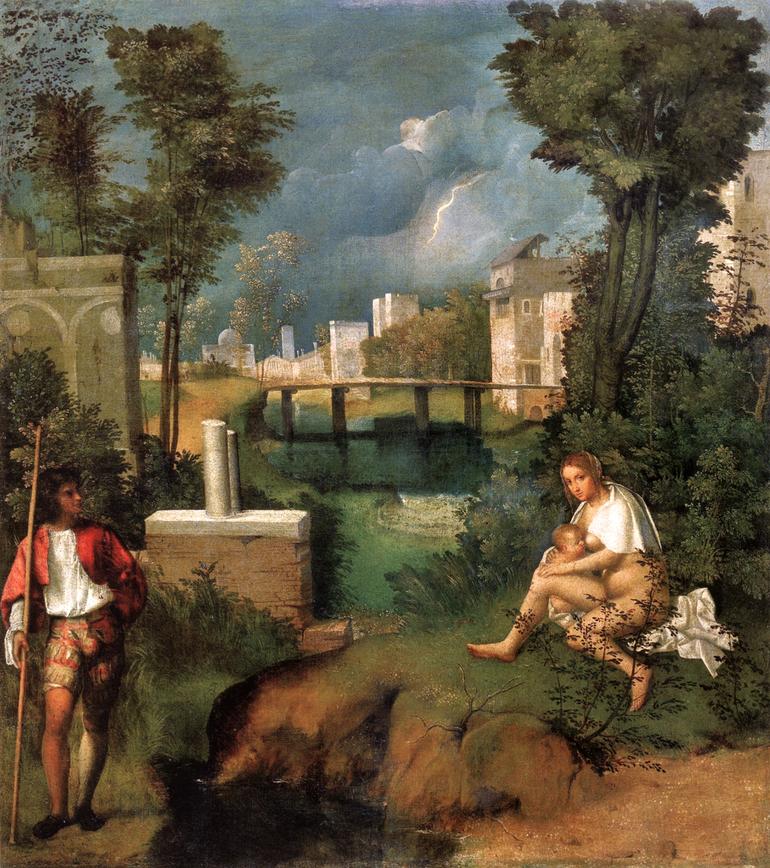
The Venetian patrician Marcantonio Michiel mentions in his "Notizie d'opere del disegno" a painting seen in the Palazzo Vendramin in Venice in 1530: "el paesetto in tela cun la tempesta, cum la cingana [gypsy] et soldato ... de man de Zorzi de Castefranco." All critics identify t...

Photo · Ria B.

GIORGIONE'S STORM — Venezia, Italy.

Location
Venezia
Type
Art, Theaters and Museums
Opening hours
Weather now
↗ Directions

About GIORGIONE'S STORM

GIORGIONE'S STORM - Venezia | Secret World Trip Planner

The Venetian patrician Marcantonio Michiel mentions in his "Notizie d'opere del disegno" a painting seen in the Palazzo Vendramin in Venice in 1530: "el paesetto in tela cun la tempesta, cum la cingana [gypsy] et soldato ... de man de Zorzi de Castefranco." All critics identify the painting described with this one by Giorgione. At least until the 18th century it was part of the Vendramin collection. In 1875 it became the property of the Giovannelli princes, who sold it to the Italian state in 1932. It is currently in the Gallerie dell'Accademia in Venice.

Generations of scholars have spilled rivers of ink in an attempt to understand what the painting "really" represents. What relationship binds the people painted in that beautiful landscape? Is the walled city real or imaginary? And why is a storm about to break out? Is it a story (mythological, biblical...), an allegory or, even, a pure fantasy of the artist? This is not the first time that a painting has been the subject of different interpretations (we need only recall Botticelli's La Primavera, but also Piero della Francesca's The Flagellation of Urbino and Titian's L'Amor Sacro e l'Amor profano), but on The Tempest the positions of critics are even irreconcilable. And each scholar in proposing "his" interpretation demolishes those that preceded him--being in turn demolished by the next critic. What follows is a brief, not complete, list of the various hypotheses.

Until the mid-19th century, the scene was interpreted, perhaps somewhat naively, as a portrait of the artist with his family, and the painting was titled The Family of Giorgione. Then, it was thought to be a depiction derived from ancient mythology: either from Statius' Thebaid (Adrastus discovers in a forest Hypsipyle who is suckling Ofelte, son of Lycurgus) or from Ovid's Metamorphoses (Deucalion and Pyrrha, the progenitors of mankind who survived the universal flood). Some saw it as a collage of abstract "personifications": the Fortress (the soldier) and Charity (the woman) in perpetual struggle against the unpredictability of Fortune (the lightning bolt that rips through the clouds). Some others have seen in it a complicated esoteric interpretation of the biblical account of the "Finding of Moses" on the banks of the Nile. And equally complicated is the interpretation of those who relate the scene to an allegorical Renaissance novel by Francesco Colonna (Hypnerotomachia Poliphili), laden with references to Egyptizing Hermeticism: the woman is Isis and Venus together, "mother of all things," the origin and end of everything. There are those who bet that it is Adam and Eve after the expulsion from Eden: Adam rests from his labors, Eve nurses the baby Cain, delivered in pain, the city in the background is the lost Eden, the lightning symbolizes divine wrath. And those who claim that the Tempest is the "blanket" of the portrait of the Venetian captain Erasmo da Narni known as Gattamelata and represents him near Treviso, the city whose walls he was to rebuild. And we cannot be silent that in 1998 a book by J. Manuel de Prada, entitled precisely The Tempest, proposed a new, albeit fictionalized, reading of the painting.


✦ Secret World · suggested day

A perfect day in Venezia

Start with GIORGIONE'S STORM, then continue with nearby places selected by Secret World.

  1. 01
    Morning
    GIORGIONE'S STORM
    📍 Venezia
    Start here
  2. 02
    Afternoon
    📍 0 km away
  3. 03
    Evening
    📍 0.9 km away

Collect this place

Turn places you discover into stamps in your Secret Passport.

Open Secret Passport →

Keep exploring · Venezia

Frequently Asked Questions

Giorgione's Storm is currently housed in the Gallerie dell'Accademia in Venice, where it has been part of the Italian state collection since 1932. The painting was originally kept in the Palazzo Vendramin in Venice during the 16th century before passing through various private collections, including the Giovannelli princes, before becoming a public treasure.
The painting's true meaning remains one of art history's greatest mysteries, with scholars proposing interpretations ranging from mythological scenes (like Deucalion and Pyrrha from Ovid's Metamorphoses) to abstract allegories and pure artistic fantasy. Marcantonio Michiel's 1530 documentation only confirms it shows a gypsy and soldier in a stormy landscape, leaving the actual narrative deliberately ambiguous and open to interpretation.
The painting dates back to the early 16th century and was first documented in 1530 by Venetian scholar Marcantonio Michiel in his 'Notizie d'opere del disegno,' when he saw it in the Palazzo Vendramin collection. This makes it one of the Renaissance's most enigmatic works, having fascinated art historians for nearly 500 years with its mysterious subject matter.
The painting deliberately resists a single interpretation, as Giorgione provides no clear narrative clues—just a walled city, two figures, and an approaching storm rendered in a beautiful landscape. Each generation of scholars has proposed different theories (from family portrait to mythological scene to pure allegory), with new interpretations consistently contradicting those that came before, making it a uniquely unsolvable masterpiece.
When viewing the painting at the Gallerie dell'Accademia, remember that Giorgione's Storm is intentionally enigmatic—there's no 'correct' answer to what it represents, so enjoy forming your own interpretation based on the atmospheric landscape, the mysterious figures, and the impending storm. The painting's genius lies in its ambiguity, making it one of the most thought-provoking works in the entire gallery collection.

Experiences nearby · Venezia

Powered by Viator

See more on Viator.com