




← Back

Fatehpur Sikri,the unseen India

Fatehpur Sikri, Uttar Pradesh 283110, India ★★★★☆ 1,652 views
Marika Sue
Fatehpur Sikri
🏆 AI Trip Planner 2026

Get the free app

Discover the best of Fatehpur Sikri with Secret World — the AI trip planner with 1M+ destinations. Get personalized itineraries, hidden gems and local tips. Free on iOS & Android.

🧠 AI Itineraries 🎒 Trip Toolkit 🎮 KnowWhere Game 🎧 Audio Guides 📹 Videos
Scan to download iOS / Android
Scan for AppGallery Huawei users

About Fatehpur Sikri,the unseen India

Fatehpur Sikri,the unseen India  - Fatehpur Sikri | Secret World Trip Planner

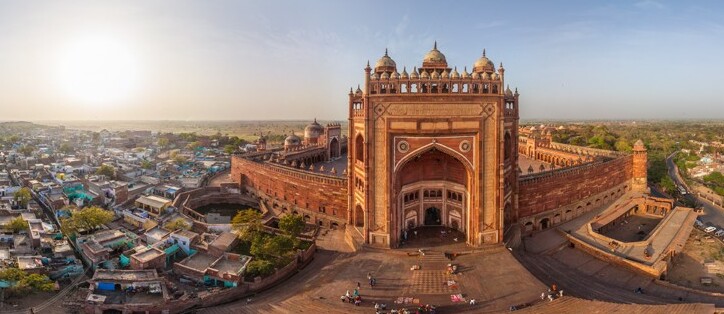
Built during the second half of the 16th century by the Emperor Akbar, Fatehpur Sikri (the City of Victory) was the capital of the Mughal Empire for only some 10 years. The complex of monuments and temples, all in a uniform architectural style, includes one of the largest mosques in India, the Jama Masjid. It was constructed southeast of an artificial lake, on the slopping levels of the outcrops of the Vindhyan hill ranges. Known as the “city of victory”, it was made capital by the Mughal emperor Akbar (r. 1556-1605 CE) and constructed between 1571 and 1573. Fatehpur Sikri was the first planned city of the Mughals to be marked by magnificent administrative, residential, and religious buildings comprised of palaces, public buildings, mosques, and living areas for the court, the army, the servants of the king and an entire city. Upon moving the capital to Lahore in 1585, Fatehpur Sikri remained as an area for temporary visits by the Mughal emperors. The inscribed property covers 60.735 ha, with a buffer zone of 475.542 ha. The city, which is bounded on three sides by a wall 6 km long fortified by towers and pierced by nine gates, includes a number of impressive edifices of secular and religious nature that exhibit a fusion of prolific and versatile Indo-Islamic styles. The city was originally rectangular in plan, with a grid pattern of roads and by-lanes which cut at right angles, and featured an efficient drainage and water management system. The well-defined administrative block, royal palaces, and Jama Masjid are located in the centre of the city. The buildings are constructed in red sandstone with little use of marble. Diwan-i-Am (Hall of Public Audience) is encircled by a series of porticos broken up at the west by the insertion of the emperor’s seat in the form of a small raised chamber separated by perforated stone screens and provided with pitched stone roof. This chamber communicates directly with the imperial palace complex clustered along a vast court. At the north side of it stands a building popularly known as Diwan-i-Khas (Hall of Private Audience), also known as the ‘Jewel House’. Other monuments of exceptional quality are Panch Mahal, an extraordinary, entirely columnar five-storey structure disposed asymmetrically on the pattern of a Persian badgir, or wind-catcher tower; the pavilion of Turkish Sultana; Anup Talao (Peerless Pool); Diwan-Khana-i-Khas and Khwabgah (Sleeping Chamber); palace of Jodha Bai, the largest building of the residential complex, which has richly carved interior pillars, balconies, perforated stone windows, and an azure-blue ribbed roof on the north and south sides; Birbal’s House; and the Caravan Sarai, Haram Sara, baths, water works, stables and Hiran tower. Architecturally, the buildings are a beautiful amalgamation of indigenous and Persian styles.

Fatehpur Sikri,the unseen India  - Fatehpur Sikri | Secret World Trip Planner
🗺 L'app dei tesori italiani

Plan your visit to Fatehpur Sikri

Suggested itinerary near Fatehpur Sikri,the unseen India

MAJ+
500.000+ travelers worldwide
  1. 🌅
    Morning
    Fatehpur Sikri,the unseen India
    📍 Fatehpur Sikri
  2. ☀️
    Afternoon
    Fatehpur Sikri
    📍 0 km · Fatehpur Sikri

Buy Unique Travel Experiences

Powered by Viator

See more on Viator.com

Explore nearby · Fatehpur Sikri

Frequently Asked Questions

Emperor Akbar built Fatehpur Sikri as the Mughal capital between 1571-1573, but relocated the capital to Lahore in 1585 after only about 10 years. While the exact reasons aren't detailed in historical records, the city remained as an area for temporary visits by subsequent Mughal emperors rather than being completely abandoned.
The primary attraction is the Jama Masjid, one of the largest mosques in India, which stands as the centerpiece of this UNESCO-inscribed complex. The city also features magnificent secular and religious buildings including palaces, the Diwan-i-Am (Hall of Public Audience), and administrative structures, all constructed in distinctive red sandstone with Indo-Islamic architectural fusion.
The inscribed property covers 60.735 hectares with a buffer zone of 475.542 hectares, bounded on three sides by a 6 km long fortified wall pierced by nine gates and reinforced with towers. The original city was rectangular in plan with a grid pattern of roads and an efficient drainage and water management system.
Fatehpur Sikri showcases a fusion of prolific and versatile Indo-Islamic architectural styles with buildings primarily constructed in red sandstone with minimal use of marble. The city features uniform architectural design across all its monuments, making it the first planned city of the Mughals with well-defined administrative blocks, royal palaces, and religious structures.
The Diwan-i-Am (Hall of Public Audience) is encircled by a series of porticos, with the emperor's seat positioned at the west in a small raised chamber separated by perforated stone screens and topped with a pitched stone roof. This chamber directly communicates with the imperial palace complex, making it a fascinating example of Mughal administrative architecture and royal protocol.