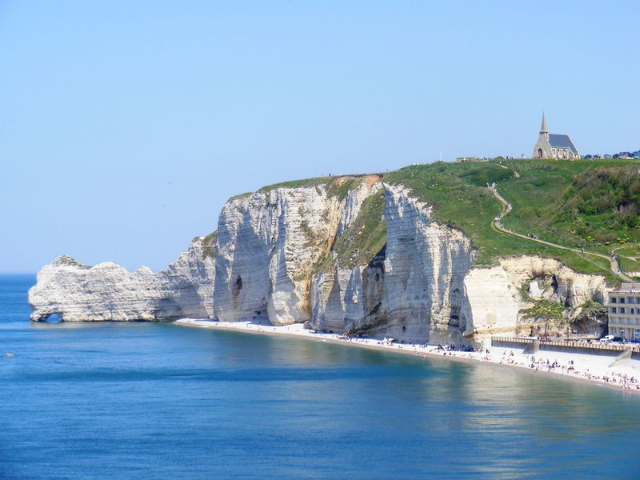

The Falaise d’Amont is the cliff on the other side of the beach, to the right when looking out to sea, and less than a century ago it was called Falaise du Blanc-Trait (White Line Cliff), because of the whiteness of the chalk, visible from the open sea a great distance away.
How can we not pay tribute to Maupassant‘s keen sense of observation, who in “Une vie” compares the Arche d’Amont (arch) to an elephant dipping its trunk in the sea? It’s all there: the trunk, the head and ears, the front and back limbs and even a Maharajah’s palanquin on its back!