
← Back

Fabbricciano and the church of Santa Maria delle Nevi

Str. della Cappellina, 85, 53034 Colle di Val d'Elsa SI, Italia ★★★★☆ 197 views
Klaira Tanya
Colle di Val d'Elsa
🏆 AI Trip Planner 2026

Get the free app

Discover the best of Colle di Val d'Elsa with Secret World — the AI trip planner with 1M+ destinations. Get personalized itineraries, hidden gems and local tips. Free on iOS & Android.

🧠 AI Itineraries 🎒 Trip Toolkit 🎮 KnowWhere Game 🎧 Audio Guides 📹 Videos
Scan to download iOS / Android
Scan for AppGallery Huawei users

About Fabbricciano and the church of Santa Maria delle Nevi

Fabbricciano and the church of Santa Maria delle Nevi - Colle di Val d'Elsa | Secret World Trip Planner

The first news of Fabbricciano and its church date back to 1134 when in a document, where, however, reference is made to the Church of Saints Donato and Biagio, the place is mentioned as part of the heritage of the Monastery of Marturi. Other subsequent documents (1228 and 1379) also refer to the Church of San Biagio. In a later period, in Fabbricciano, reference is made to a church dedicated to Santa Maria and San Pietro. Its current construction dates back to the 16th century and is a work disputed between Giuseppe Marchini and Antonio da Sangallo the Elder. It belonged to the Sabolini family.

Fabbricciano and the church of Santa Maria delle Nevi - Colle di Val d'Elsa | Secret World Trip Planner

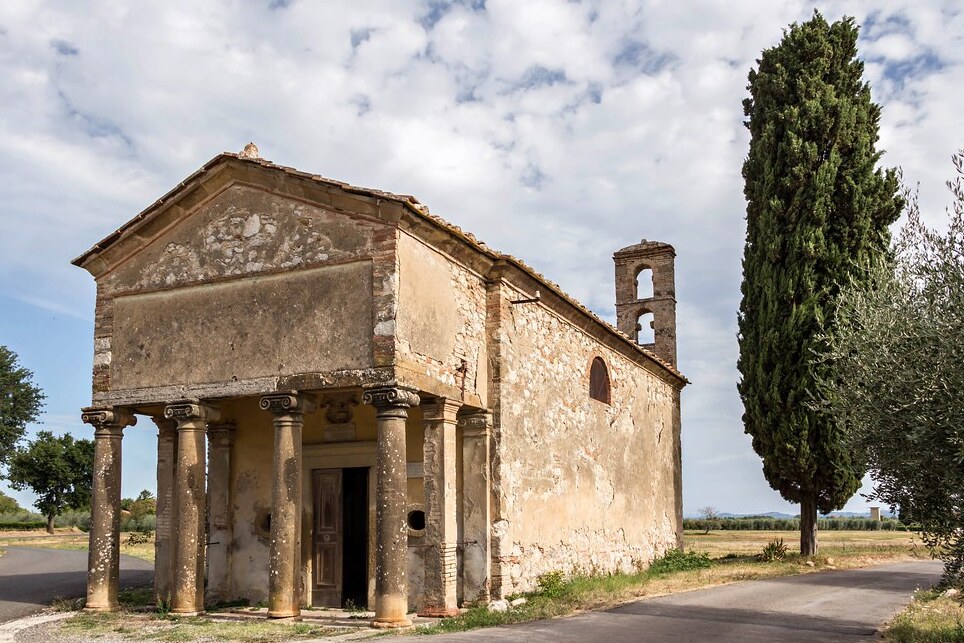
The church of Santa Maria delle Nevi is in Renaissance style. The exterior is characterized by a gabled façade with a portico in the lower part; this, covered with a barrel vault, is supported at the front by four smooth Ionic columns and, laterally, by two square pillars. Under the portico there is the portal, flanked by two oval oculi. On the rear part of the church there is the bell tower with two superimposed arches. Inside, the church has a rectangular plan, with a single nave.


Fabbricciano and the church of Santa Maria delle Nevi - Colle di Val d'Elsa | Secret World Trip Planner
🗺 L'app dei tesori italiani

Plan your visit to Colle di Val d'Elsa

Suggested itinerary near Fabbricciano and the church of Santa Maria delle Nevi

MAJ+
500.000+ travelers worldwide
  1. 🌅
    Morning
    Fabbricciano and the church of Santa Maria delle Nevi
    📍 Colle di Val d'Elsa
  2. ☀️
    Afternoon
    The Elsa river and the turquoise of wonders
    📍 3.2 km · Colle di Val d'Elsa
  3. 🌆
    Evening
    Tuscany | San Gimignano
    📍 7.1 km · Colle di Val d'Elsa

Buy Unique Travel Experiences

Powered by Viator

See more on Viator.com

Explore nearby · Colle di Val d'Elsa

Frequently Asked Questions

Fabbricciano was first documented in 1134 as part of the Monastery of Marturi's heritage, initially featuring the Church of Saints Donato and Biagio. The area later developed a church dedicated to Santa Maria and San Pietro, with the current Church of Santa Maria delle Nevi being constructed in the 16th century as a work attributed to Giuseppe Marchini and Antonio da Sangallo the Elder, and it belonged to the Sabolini family.
The Church of Santa Maria delle Nevi is built in Renaissance style, featuring a distinctive gabled façade with a barrel-vaulted portico supported by four smooth Ionic columns at the front and two square pillars on the sides. Inside, the church maintains a simple rectangular plan with a single nave design.
The church's exterior showcases a gabled façade with a covered portico entrance, flanked by two oval oculi windows on either side of the main portal. On the rear, there is a bell tower with two superimposed arches that adds to the Renaissance composition of the building.
The construction of the Church of Santa Maria delle Nevi in the 16th century is a disputed work between two renowned architects: Giuseppe Marchini and Antonio da Sangallo the Elder. Both architects were significant figures in Renaissance design, making this church an important example of their period's architectural contributions.
Visitors should admire the Renaissance portico with its four elegant Ionic columns and the portal framed by two oval oculi, as well as the bell tower with superimposed arches visible from the rear. Inside, the single-nave rectangular interior offers a serene Renaissance interior space worth exploring for its architectural proportions and design.