At a 2565 meters above sea level, the air is humid and dense, the branches of the trees disappear wrapped in fog, and the moss covers every surface like a green and silent blanket. Doi Inthanon is the highest peak in Thailand, located in the eponymous national park in Chiang Mai province, not far from the village of Ban Luang. Those who arrive here expecting the tropical heat of Thailand instead find themselves in an environment that resembles more the temperate forests of Europe than Southeast Asia.

The Doi Inthanon National Park was established in 1972 and covers an area of over 480 square kilometers. The summit hosts a cloud forest characterized by large trees entirely covered in moss, ferns, and lichens. This unique ecosystem is the result of the constant humidity brought by the clouds that form around the peak almost all year round, creating a very particular microclimate compared to the rest of the country.
The trails in the cloud forest

The most well-known path in the summit area is the Nature Trail, which starts near the summit parking lot and winds for about a kilometer through the cloud forest. The trail is well-marked and can be traversed in about 30-45 minutes, but those who walk slowly — stopping to observe the trunks covered in moss often several centimeters thick — may take twice as long. The informational panels along the route describe the local flora, including numerous varieties of wild orchids that grow directly on the branches of trees.
Walking along the trail gives the feeling of crossing a suspended world: light filters through the canopy with difficulty, the ground is soft and damp underfoot, and the silence is broken only by the singing of birds. Doi Inthanon is considered one of the most important places for birdwatching in Thailand, with endemic species such as the Doi Inthanon fulvetta and the green-tailed sunbird, which are rarely spotted elsewhere in the country. Experienced birdwatchers often arrive at dawn when the birds are most active.
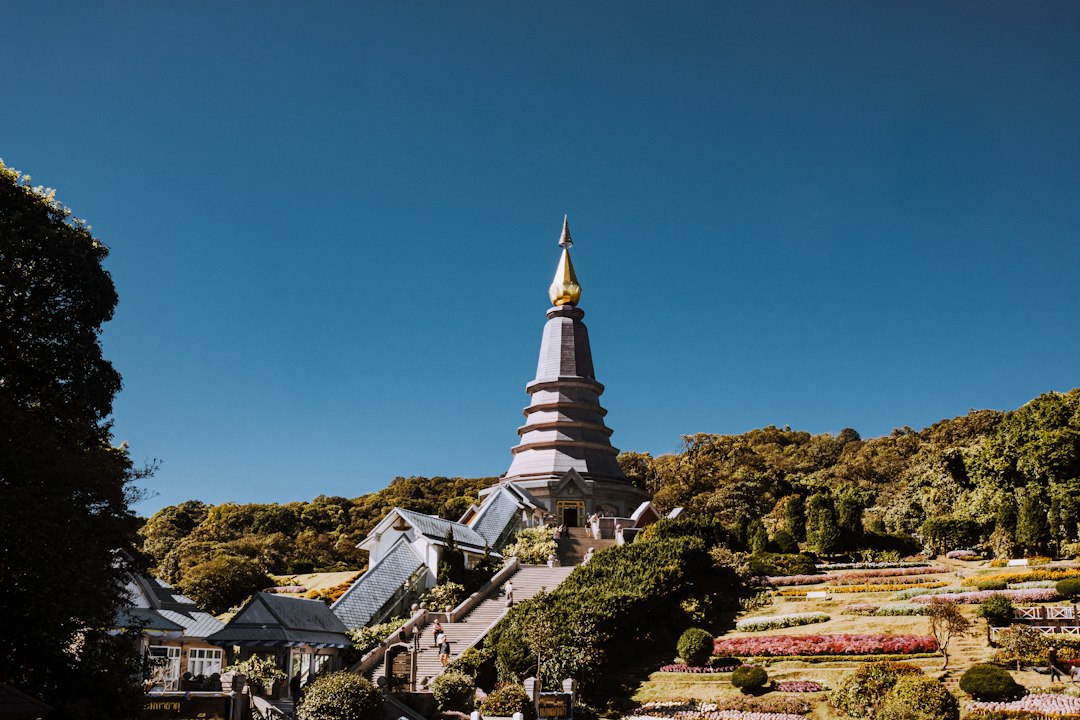
The two royal chedis at the summit
Near the peak, there are two pagodas, known as Naphamethinidon and Naphaphonphumisiri, built between the late 1980s and the early 1990s in honor of King Bhumibol Adulyadej and Queen Sirikit on the occasion of their respective birthdays. The structures are surrounded by well-maintained gardens with flowers and ornamental plants, a stark visual contrast to the surrounding wild forest.

During the central hours of the day, the chedis are often shrouded in mist, which arrives quickly and can reduce visibility to just a few meters. This phenomenon, far from being an inconvenience, adds an almost surreal atmosphere to the place: the golden spires emerge and disappear among the clouds, and visitors move through the gardens enveloped in a diffuse and milky light. Entrance to the chedis' gardens requires respectful attire — shoulders and knees covered — and sarongs are available at the entrance for those who are not appropriately dressed.
How to get there and when to visit

The most convenient way to reach the summit of Doi Inthanon is to rent a car or a motorcycle in Chiang Mai and drive about 90 kilometers west. The road that leads to the peak is paved and in good condition, but requires attention in the narrower sections. Alternatively, several agencies in Chiang Mai offer day tours that include transportation and the accompaniment of a local guide.
The entrance ticket to the national park is 300 baht for adult foreigners. The temperature at the summit can drop below 10 degrees Celsius during the winter months — from November to February — and it is advisable to bring a jacket even in the middle of summer, when fog and humidity make the air cool. The best time to visit the summit is early in the morning, before the tourist buses arrive in greater numbers and before the afternoon fog reduces visibility on the trails.
Practical tips for the trail
Trekking shoes with non-slip soles are essential: the terrain of the Nature Trail is constantly damp and the wooden sections can become slippery. Those who are sensitive to the cold should bring a second layer of clothing to keep in their backpack, as the temperature changes significantly between the valley floor and the summit during the same day.
It is useful to know that the national park has some accommodation facilities and refreshment points along the main road, but at the summit, the options are limited. It is advisable to bring water and something to eat, especially if you plan to spend more time on the trails. Finally, those who want to spot endemic birds should consider bringing binoculars: many of the rarer species move among the canopies of the tallest trees, out of direct line of sight.