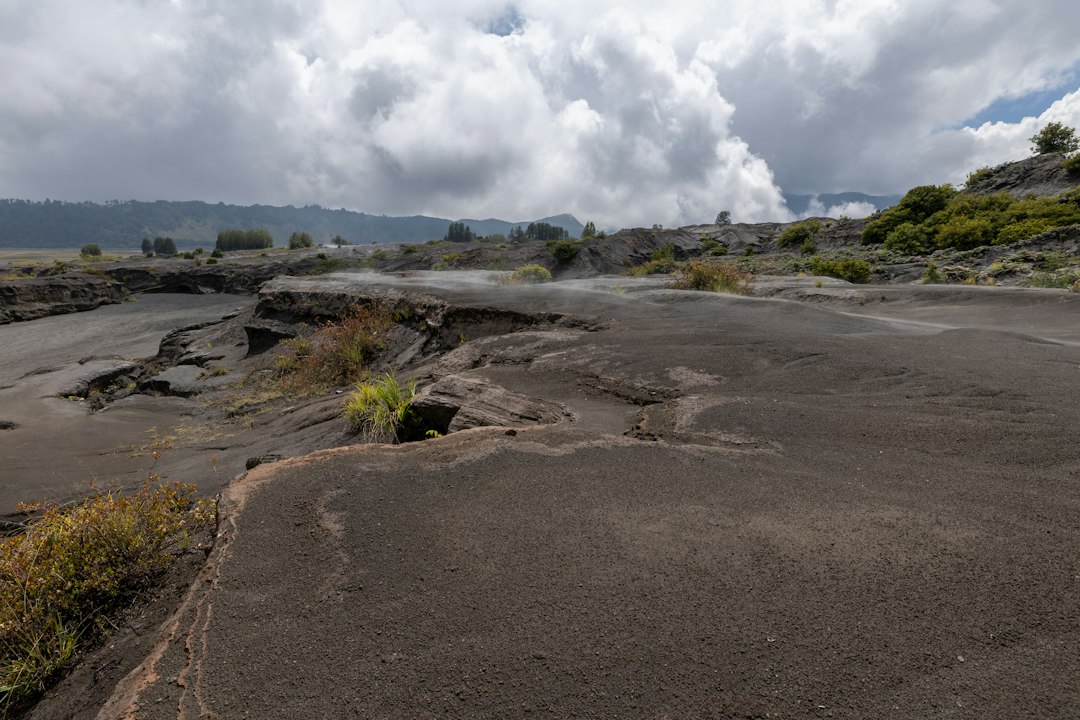

At four in the morning, when the darkness is still thick and the biting air stings the skin, hundreds of visitors board 4x4 jeeps that traverse the Tengger Caldera, a plain of volcanic ash locally called Lautan Pasir — the Sea of Sand. The ground is gray, lunar, devoid of vegetation, and stretches for about ten square kilometers around the cone of Mount Bromo. There is no other place on Earth that resembles this.

The Mount Bromo, located in the Sukapura district of East Java province, is one of the most active volcanoes in Indonesia and reaches an altitude of 2,329 meters above sea level. It is not the highest in the region — the nearby Mount Semeru, visible on the horizon, reaches 3,676 meters — but it is undoubtedly the most scenic. Its crater smokes almost continuously, and the smell of sulfur permeates the air as one approaches the edge.
The Breathtaking Landscape

The most extraordinary feature of Bromo is not the volcano itself, but the context in which it is located. The Tengger caldera is a depression formed by an ancient catastrophic eruption, and within it are several volcanic cones, including Bromo, the Batok (inactive, with its perfectly striped sides) and Kursi. The visual contrast between the gray plain and the cones emerging from it creates an almost surreal effect, as if someone had drawn volcanoes on a sheet of gray paper.
At dawn, when the pink and orange light begins to tint the sky, the white smoke rising from the Bromo crater is illuminated from within. From the Penanjakan viewpoint, located at about 2,770 meters above sea level, one has an overview of the caldera that has become one of the most photographed images in all of Asia. It is worth arriving at least half an hour before dawn to find a spot on the edge of the platform, because during peak hours it can be very crowded.

The Descent into the Crater
After admiring the sunrise from Penanjakan, most visitors descend into the caldera and cross the Sea of Sand on foot or horseback to the base of the Bromo cone. From there, a staircase of 253 steps leads to the edge of the crater, where the ground trembles slightly and the sulfurous smoke can become thick. It is advisable to bring a mask or a scarf to use as a filter, especially if the wind blows towards the path.

The crater is about 800 meters wide and about 200 meters deep. It is not possible to descend inside, but looking over the edge and down, where the live rock is colored yellow and gray and the smoke rises in spirals, is an experience that remains etched in memory. The Tengger community, which inhabits the villages around the caldera, considers Bromo a sacred mountain and every year celebrates the Yadnya Kasada festival, during which flowers, food, and livestock are offered to the crater.
How to organize the visit

The most common way to reach Bromo is to depart from the city of Probolinggo, which is located on the northern coast of Java and has a train station connected to Surabaya and Malang. From Probolinggo, you take a shared minibus to the village of Cemoro Lawang, which is the main starting point for the caldera. The journey takes about an hour and a half. Alternatively, many tourists organize private tours from Malang or Surabaya that include jeep transportation.
The entrance ticket to the Bromo Tengger Semeru National Park costs about 220,000 Indonesian rupiah on weekdays and rises to about 320,000 rupiah on weekends and holidays for foreign visitors (the figures may vary, it is always best to check before departure). The best time to visit is the dry season, between April and October, when the sky is clearer and the chances of seeing a clear sunrise are higher. During the rainy season, from November to March, the caldera can be shrouded in fog for entire days.
What to bring and what to expect
Temperatures in the caldera at night and dawn can easily drop below 5 degrees Celsius, even in the warmest months. Layered clothing, gloves, and a hat are essential, not optional. Many visitors underestimate the cold and find themselves struggling even during the ascent to Penanjakan. Locals rent heavy jackets at the park gates, but the quality is variable.
The minimum recommended time for a satisfying visit is one night and one morning: arrive in Cemoro Lawang in the afternoon, sleep there, wake up at three to reach Penanjakan, descend into the caldera after dawn, and visit the crater. Those with more time can stay for two nights to explore the surroundings more leisurely, including the sand hills located east of the caldera, where the landscape becomes even quieter and more desolate.