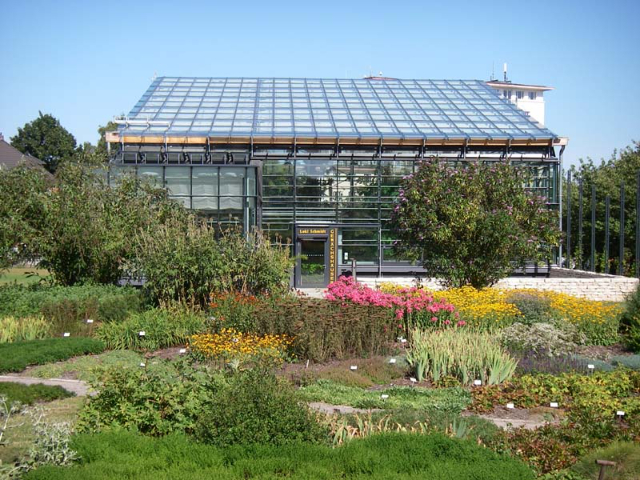

Botanical garden founded at the end of the 19th century at the local university. On the 7.8 hectare there are about 10,000 plants from around the world. It is divided into several smaller parts.

The outdoor garden is comprised of the following sections: The systematics section and the corresponding arboretum display around 2500 plant species grouped according to their scientifically determined evolutionary relatedness and provide evidence of the progress in plant evolution that has occurred on different evolutionary paths during many millions of years. On the basis of some 350 species, the morphological section presents some of the many unique features that plants have evolved as essential adaptations to survive in their environment and that can be characterized as plant functional types. In these cases, the role of survival and passing genes on to the next generation through reproduction has provided the catalyst for the emergence of diverse, yet stunningly similar morphological blueprints in different plant groups. In the officinal plants section, over 200 species used as medicinal, medical, spice, dye, fiber, and technology plants are grouped according to their main constituents and their resulting uses. The section on the history of useful plants in northeastern Germany displays some 60 species that were introduced to the area of present northeastern Germany since the Neolithic Age, referring to epochs of human history and species occurrance to a significant extent.
In other areas of the garden, the habitat sections, the plants are allowed to grow as they would in nature (for the most part). Ecological characteristics of the site and interactions amongst plants account for the important factors in these sections. In addition to dune and intermediate bog habitats, spring and wetland meadows, sandy dry grassland, beech forest and alder carr, a small stream and three ponds reflect the influence that different ecological habitats have on the evolution of diversity in the plant kingdom. In the alpine garden, housing some 1500 species, one can see how plants on high montane and sub-alpine levels have adapted to a complex of extreme environmental conditions, including both acidic and basic rocky outcrops. The plants have evolved some peculiar and colorful adaptations. Even when belonging to very different systematic groups, these plants show some stunning similarities.
Smaller sections include the Japanese garden, a collection of evergreen plants, and a section of protected native plant species. Separate sections of an educational garden, a therapeutic garden, and a bee information garden are run by external partners.
The greenhouses contain collections (some 1000 species) of tropical crop plants and rainforest plants, subtropical species from deserts and semi-deserts around the world, and species of Mediterranean climates from four continents. The geographical focus of our collections is mainland Africa, Madagascar, and the Canary Islands (paleotropics). Special collections include a number of desiccation-tolerant resurrection plants and carnivorous plants that research projects focus on.