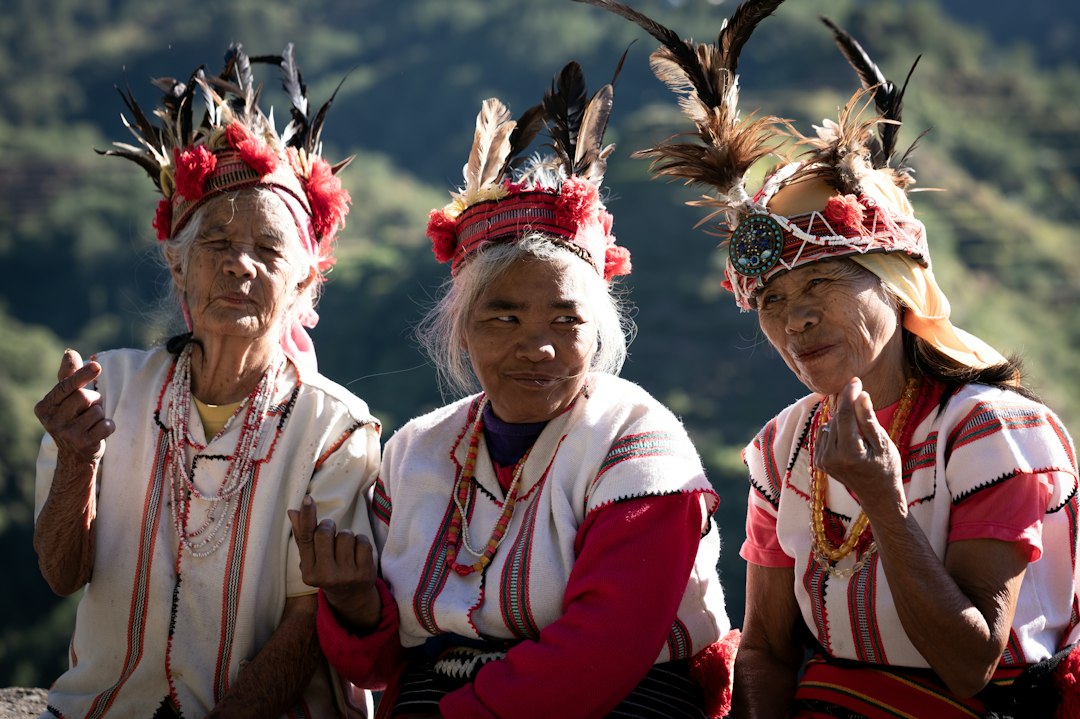

At the first light of dawn, when the fog slowly descends from the peaks of the Cordillera and envelops the slopes like a veil of gray silk, the terraces of Batad emerge from the mist in all their ancestral geometry. This is not a landscape built to be admired: these stone and earth terraces, which rise endlessly along the mountain walls, are still cultivated fields today, just as they were over two thousand years ago when the Ifugao people hand-carved them into the hillsides.

Batad is a remote village in the Banaue district, in the province of Ifugao, on the island of Luzon. Its terraces are part of the broader system of the Ifugao Rice Terraces, recognized by UNESCO as a World Heritage Site in 1995. What distinguishes Batad from other terraced areas in the region is its amphitheater shape: the terraces develop in a semicircle around the village, creating a sort of natural theater where the scene is the landscape itself.
The colors that change with the light of day

The color palette of the terraces of Batad is anything but uniform, and changes radically depending on the hour and the season. In the early hours of the morning, when the sun has not yet crossed the eastern ridge, the stone walls appear almost black due to the night humidity, while the water basins — present when the fields are flooded for planting — reflect the sky like irregular mirrors set in the mountain. It is the moment when the contrast between the ancient gray of the stone and the bright green of the rice shoots reaches its maximum intensity.
By mid-morning, with the light coming down more directly, the terraces take on a vivid emerald green hue, almost unreal. The stone retaining walls, high in some places up to 1.5 meters, cast sharp shadows that enhance the three-dimensionality of the landscape and make visible the layering of human work. At sunset, on the other hand, everything is tinged with orange and gold: the water basins capture the colors of the sky and the village below, with its traditional Ifugao houses with sloping roofs, seems to almost float amidst a luminous mosaic.
The water system that made everything possible
One of the most surprising aspects that can be directly observed while walking along the paths that cross the terraces is the irrigation system. The Ifugao have developed over the centuries a network of channels and bamboo pipes that distributes water from mountain springs to each individual terrace, following a precise order that ensures water flows from top to bottom without waste. Even today, this system operates without pumps or modern infrastructure.
Walking among the stone walls, one can clearly see the small channels dug into the ground and the slanted bamboo sections that channel water from one level to another. It is an empirical hydraulic engineering, refined over generations, that has allowed rice — a crop that requires a lot of water — to be cultivated on slopes that would otherwise be inaccessible to agriculture. The rice grown here is mainly a traditional local variety, different from the hybrid varieties widespread in the plains.
How to get there and what to expect on site
Reaching Batad takes time and a bit of physical effort, and it is good to know this before leaving. From Manila, you take an overnight bus to Banaue — the journey takes about 8-9 hours — and from Banaue, you travel a dirt road in a jeepney or in 4x4 vehicles to the so-called saddle point, the saddle point from which the hiking trail begins. From there, the descent on foot to the village takes about 30-45 minutes, but the return uphill can be challenging, especially with heat and humidity.
The most useful practical advice is to leave Banaue early in the morning, ideally by 7:00 AM, to arrive at the terraces when the light is still low and the fog has not yet completely dissipated. Avoid the months of December and January, when the rains can make the trails slippery and dangerous. The best time to visit is between June and July, when the terraces are flooded and green, or between March and May, just before planting, when the landscape takes on drier and more golden colors. There is no formal entrance ticket for the terraces themselves, but it is a well-established practice to pay a small fee to the village as a contribution to the local community.
The silence as part of the landscape
What strikes you the most, once you descend into the village and start along the paths between the terraces, is the silence. Not an absolute silence — you can hear the water flowing in the channels, the wind among the rice plants, a few distant voices — but a quiet that sharply contrasts with the noise of any city. The terraces of Batad are not a sight to be viewed from a viewpoint: you cross them, you walk through them, you breathe them in. And in that enforced slowness, you understand something of the time needed to build them.