
← Back

Abbey of Monte Maria: the highest Benedictine Abbey in Europe

39024 Convento Monte Maria BZ, Italia ★★★★☆ 413 views
Sara Miles
Convento Monte Maria
🏆 AI Trip Planner 2026

Get the free app

Discover the best of Convento Monte Maria with Secret World — the AI trip planner with 1M+ destinations. Get personalized itineraries, hidden gems and local tips. Free on iOS & Android.

🧠 AI Itineraries 🎒 Trip Toolkit 🎮 KnowWhere Game 🎧 Audio Guides 📹 Videos
Scan to download iOS / Android
Scan for AppGallery Huawei users

About Abbey of Monte Maria: the highest Benedictine Abbey in Europe

Abbey of Monte Maria: the highest Benedictine Abbey in Europe - Convento Monte Maria | Secret World Trip Planner

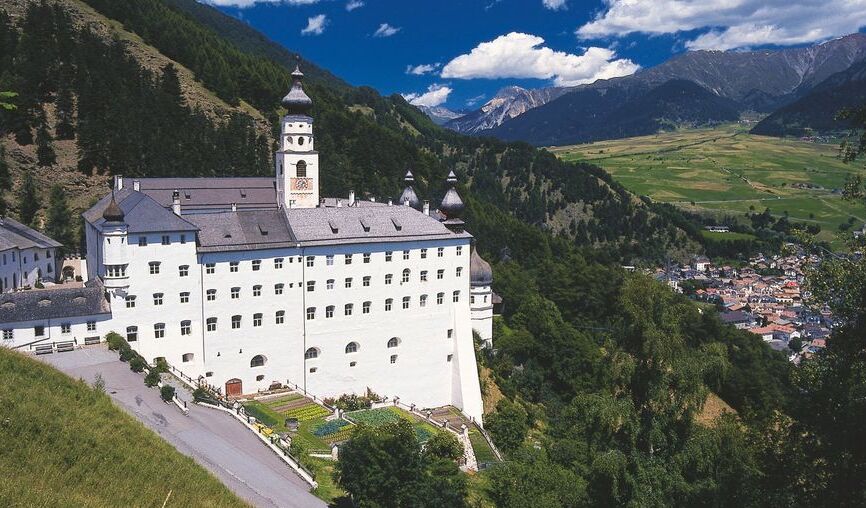
Monte Maria Abbey is the highest Benedictine Abbey in Europe. The Abbey of the Counts of Tarasp was built around 1200. The baroque church is the only three-aisled basilica in the Vinschgau Valley. The Romanesque conch portal of the 12th century has remained unchanged. Also noteworthy are the Gothic coloured plaster sculpture of Mary with Child and the fresco next to the portal from 1650 by H. J. Pfeil representing the founder Ulrich of Tarasp and Leopold of Austria with their coats of arms.

The crypt, consecrated in 1156, preserves Romanesque frescoes of Byzantine influence, considered among the most important in Europe. On the vault of the apse the figure of Christ is surrounded by the symbols of the Evangelists, Cherubim, Angels and Saints. The elongated figures of the Angels fit skilfully into the architectural partition that houses the celestial congregation. The faces are extraordinarily expressive and the eyes turn towards the central figure of Christ.

The museum is housed in some rooms of the buildings in the inner courtyard of the convent. In the showcases and rooms are displayed objects inspired by the Benedictine motto "ora et labora". There are also documents that refer to important events in the history of the abbey. The visitor is also introduced to the interpretation of the allegorical figures depicted in the crypt.

In some showcases there are documents and works of art that tell the daily life of the convent and the highlights of its almost millenary history.


🗺 L'app dei tesori italiani

Plan your visit to Convento Monte Maria

Suggested itinerary near Abbey of Monte Maria: the highest Benedictine Abbey in Europe

MAJ+
500.000+ travelers worldwide
  1. 🌅
    Morning
    Abbey of Monte Maria: the highest Benedictine Abbey in Europe
    📍 Convento Monte Maria
  2. ☀️
    Afternoon
    Chur Castle and the largest private armory in the world
    📍 7 km · Convento Monte Maria
  3. 🌆
    Evening
    The Submerged Bell Tower, Located in Lake Resia
    📍 13.3 km · Convento Monte Maria

Buy Unique Travel Experiences

Powered by Viator

See more on Viator.com

Explore nearby · Convento Monte Maria

Frequently Asked Questions

Monte Maria Abbey holds the distinction of being the highest Benedictine Abbey in Europe, offering a unique spiritual and geographical experience. Beyond its elevation, it houses one of the most important collections of Romanesque frescoes with Byzantine influence in Europe, located in the crypt that was consecrated in 1156.
The abbey features the only three-aisled baroque basilica in the Vinschgau Valley, a beautifully preserved 12th-century Romanesque conch portal, and a striking Gothic colored plaster sculpture of Mary with Child. The crypt's Byzantine-influenced frescoes depicting Christ surrounded by symbols of the Evangelists and celestial figures are considered among the most important in Europe.
Yes, the abbey operates a museum housed in the inner courtyard buildings that displays objects related to the Benedictine motto 'ora et labora' (pray and work), historical documents of important abbey events, and interpretive guides to the allegorical figures in the crypt. The museum provides insights into the daily life of monks and nearly a thousand years of the abbey's history.
The Abbey of the Counts of Tarasp was built around 1200, though its crypt dates back to 1156. The abbey was founded by Ulrich of Tarasp with the support of Leopold of Austria, as depicted in a 1650 fresco by H. J. Pfeil that still adorns the portal.
The crypt's Romanesque frescoes feature an extraordinarily expressive composition with Christ at the center surrounded by symbols of the Evangelists, Cherubim, Angels, and Saints, all rendered in Byzantine style. The elongated angel figures are skillfully integrated into the architectural design, with remarkably expressive faces and eyes all directed toward the central figure of Christ.